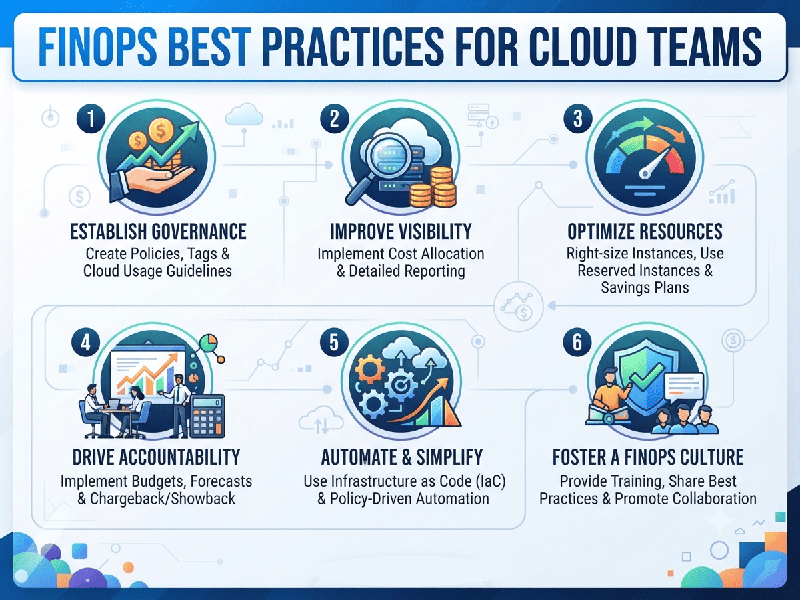
FinOps Best Practices for Cloud Teams
FinOps (Financial Operations) is an evolving cultural practice and
operational framework that brings financial accountability to the variable
spend model of cloud computing. It enables distributed teams—spanning
engineering, finance, product, and leadership—to work together to make data-driven
spending decisions, maximize business value, and accelerate cloud innovation
without compromising speed or reliability.
The Three Core Phases of the FinOps Lifecycle
FinOps operations are typically categorized into an
ongoing, iterative lifecycle:
1.
Inform (Visibility & Allocation):
o Gain granular visibility into cloud
usage and costs through comprehensive tagging and labeling strategies.
o Allocate shared costs fairly across
business units, products, or cost centers to provide accurate unit economics
(e.g., cost per customer or transaction).
2.
Optimize (Efficiency & Waste Reduction):
o Identify and eliminate idle
resources, unattached storage volumes, and oversized virtual machines.
o Leverage commitment-based discounts
(such as Reserved Instances and Savings Plans) to drive down baseline
operational costs.
3.
Operate (Alignment & Continuous Improvement):
o Establish real-time tracking, anomaly
detection alerts, and cross-functional Key Performance Indicators (KPIs).
o Foster a culture where engineering
teams balance speed, cost, and quality during the design and deployment phases.
Essential FinOps Best Practices
- Implement a Robust Tagging
Strategy:
Enforce mandatory metadata tagging policies (e.g., Owner, Environment,
CostCenter, Project) at the infrastructure-as-code (IaC) level to ensure
precise cost attribution.
- Automate Cloud Waste Detection: Use automated policies and
scripts to identify forgotten development resources, dangling IP
addresses, and orphaned snapshots that accrue unnecessary monthly charges.
- Optimize Commitment Management: Regularly review utilization
rates of Savings Plans and Reserved Instances. Utilize automated
commitment management tools to rebalance coverage as application
architectures evolve.
- Establish Real-Time Anomaly
Alerts: Set up
automated notification thresholds for unexpected cost spikes, enabling
engineering leads to investigate anomalies within hours rather than
waiting for month-end invoices.
- Shift-Left Cost Optimization: Involve cost estimation early
in the architectural design phase, encouraging engineers to evaluate cost
trade-offs before code is pushed to production.
- Measure Unit Economics: Move beyond raw cloud spend
totals by tracking efficiency metrics tied to business growth, such as
infrastructure cost per active user or per API request.