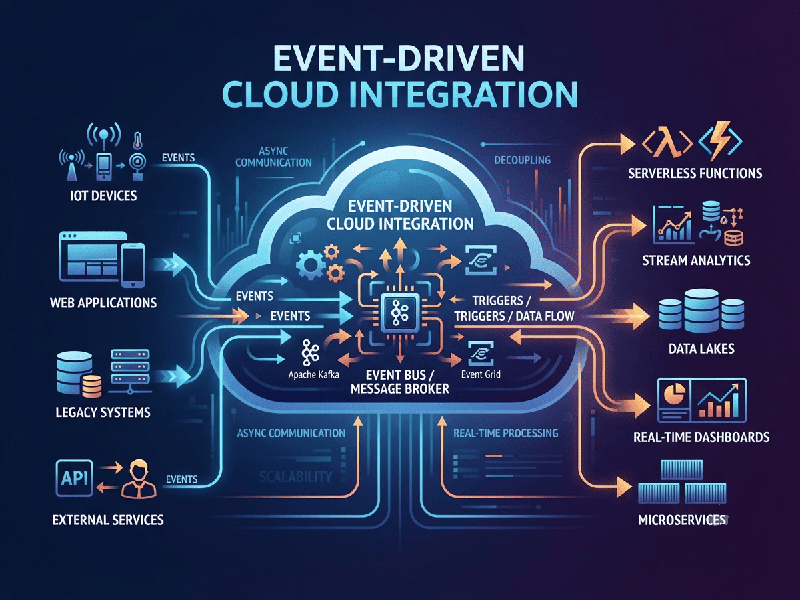
Event-Driven Cloud Integration
Event-Driven Cloud Integration is an architectural pattern that
enables different cloud services, microservices, and external applications to
communicate asynchronously through the production, detection, and consumption
of events.
Unlike traditional request-response models (like
synchronous REST APIs), where a client waits for a server to process a request
and return a response, an event-driven approach decouples the producer of an
event from the consumers. When a significant business or system occurrence
happens (an "event," such as a new user sign-up, a payment processed,
or an IoT sensor reading), an event is published to a central broker or bus,
which then routes it to any interested subscriber services.
Core Components
- Event Producer (Publisher): The service or system that
detects or generates a state change and emits an event (e.g., an order
placement service).
- Event Router / Broker: The middleware responsible for
receiving events from producers and filtering, queuing, and delivering
them to the correct consumers (e.g., AWS EventBridge, Google Cloud
Pub/Sub, Azure Event Grid, Apache Kafka).
- Event Consumer (Subscriber): The service or function that
receives the event and executes a corresponding reaction or business logic
(e.g., a shipping fulfillment service or an email notification service).
Key Benefits
- Loose Coupling: Producers and consumers operate
independently. Services can be updated, scaled, or replaced without
breaking dependent systems.
- Real-Time Responsiveness: Systems react immediately to
state changes rather than relying on periodic polling, reducing
unnecessary network traffic and latency.
- High Scalability &
Resilience: If
a consumer service goes offline, the event broker can queue messages until
the service recovers, preventing data loss and cascading failures.
- Cost Efficiency: Services scale dynamically to
zero when no events are present (especially when paired with serverless
compute like AWS Lambda or Google Cloud Functions), ensuring you only pay
for actual processing time.
Common Use Cases
- E-Commerce Order Processing: Triggering inventory updates,
payment processing, and confirmation emails simultaneously the moment an
order is placed.
- IoT & Telemetry: Ingesting massive streams of
real-time sensor data from smart devices for live analytics and automated
alerts.
- Data Synchronization: Keeping distributed databases
or external SaaS platforms (like CRM and ERP systems) updated in real time
via change data capture (CDC).