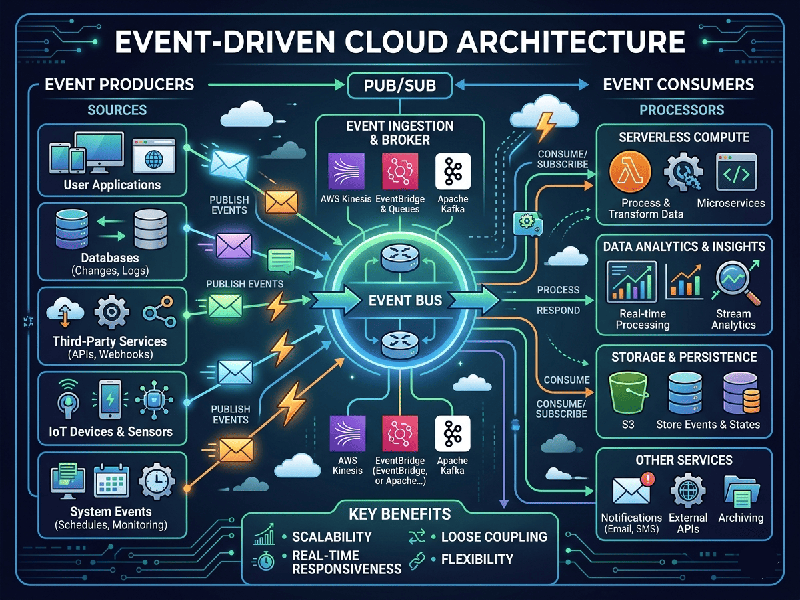
Event-Driven Cloud Architecture
Event-Driven Architecture (EDA) in the cloud is a design
pattern where the flow of the system is determined by events—significant
changes in state, such as a customer placing an order, a sensor detecting a
temperature spike, or a file being uploaded to storage.
Instead of services constantly asking each other for updates
(polling), they wait for an event to be "pushed" to them.
1. Core Components of EDA
An event-driven system consists of three main players:
- Event Producers: The source that detects a
change and publishes a message (e.g., a web front-end, an IoT device, or a
database).
- Event Routers (The Broker): The middle layer that filters
and pushes the events to the right places. Common services include AWS
EventBridge, Azure Event Grid, or Google Cloud Pub/Sub.
- Event Consumers: The services that perform an
action when an event arrives (e.g., a Lambda function that
generates an invoice or a microservice that updates inventory).
2. Key Benefits
- Asynchronous Decoupling: Producers and consumers don't
need to know about each other. If the "Invoice Service" is down,
the "Order Service" can still accept orders because the event is
safely stored in the broker.
- Scalability: Since components are
independent, you can scale the consumer services (like serverless
functions) up or down instantly based on the volume of incoming events.
- Cost Efficiency: You only pay for the compute
power used when an event actually occurs, rather than paying for a server
to sit idle waiting for requests.
- Agility: You can add new features
easily. If you want to add a "Marketing Notification" service,
you simply tell it to listen for the "Order Placed" event
without touching the original order code.