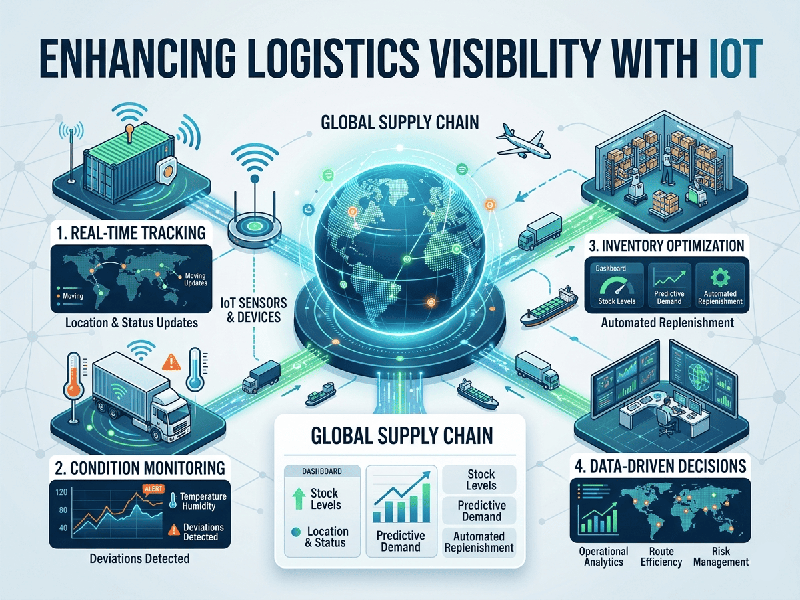
Enhancing Logistics Visibility with IoT
The integration of the Internet of Things (IoT) has moved beyond simple GPS tracking. It is now the "nervous system" of modern logistics, providing a continuous digital telemetry stream that eliminates the "black holes" of traditional supply chains.
1. Real-Time Cargo & Condition Monitoring
IoT sensors now travel with the freight, not just the
vehicle. These "Smart Printables" or smart labels are attached
directly to pallets and individual items.
- Environmental Integrity: Sensors monitor temperature,
humidity, and light exposure in real-time. This is critical for the Cold
Chain (pharmaceuticals/food), where any deviation triggers an
immediate alert to reroute or inspect.
- Tamper & Shock Detection: Accelerometers and light
sensors detect if a container has been dropped or opened prematurely,
instantly triggering insurance and security protocols.
- Indoor/Outdoor Continuity: Using a mix of GPS for transit
and Bluetooth Beacons/RFID for warehouses, assets are tracked
seamlessly from the ship to the specific shelf in a fulfillment center.
2. Fleet Intelligence & Predictive Maintenance
IoT has transformed vehicles into mobile data centers. By
2026, "Embedded AI" within these devices processes data at the edge
to make split-second decisions.
- Telematics 2.0: Beyond location, IoT devices
monitor engine diagnostics (oil pressure, vibration, fuel consumption).
AI-powered predictive maintenance can reduce equipment stoppages by 30%
to 50%.
- Dynamic Rerouting: In 2026, route calculation
software merges live IoT traffic data with active vehicle locations to
bypass congestion, reducing diesel consumption and carbon emissions.
- Driver Behavior: Real-time behavioral analytics
track acceleration, braking, and rest periods to improve safety and
provide tailored training.
3. Warehouse & Yard Automation
The "Yard" is often the biggest bottleneck in
logistics. IoT solves this through synchronized hardware.
- Dock Door Coordination: Sensors on dock doors signal
trucks exactly when to pull up, reducing "dwell time" (the time
a truck sits idle).
- Autonomous Mobile Robots (AMRs): In warehouses, IoT-connected
robots navigate independently to pick and pack goods, increasing accuracy
to nearly 99.5%.
- Asset Utilization: IoT helps track Returnable
Transport Items (RTIs) like pallets and kegs, ensuring they aren't
lost and are cycled efficiently back into the system.
4. Key 2026 Tech Enablers
- 5G & Edge Computing: Provides the low-latency
connection required for autonomous fleets and high-speed sorting.
- eSIM Technology: Allows tracking devices to
switch network providers automatically as they cross international
borders, ensuring "always-on" visibility.
- Blockchain Integration: IoT data is increasingly logged
onto a blockchain to create a tamper-proof "Digital Twin" of the
shipment for compliance and audits.