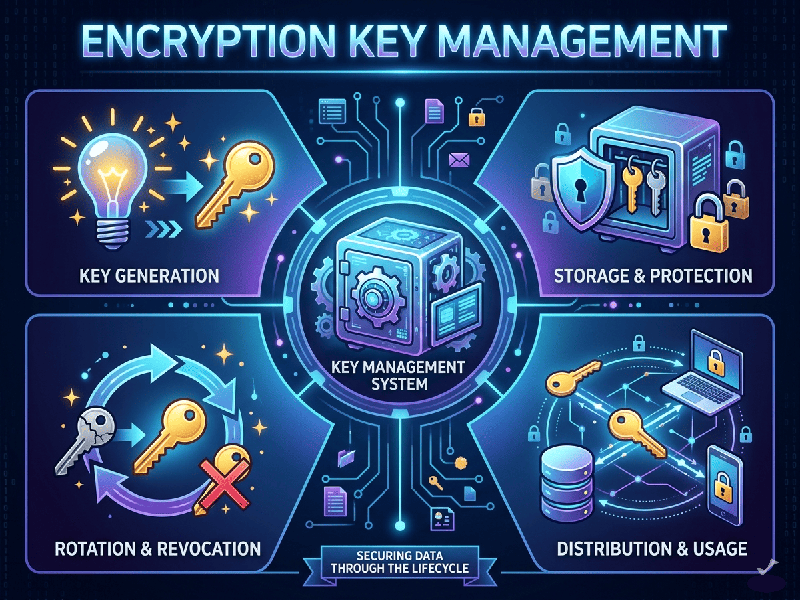
Encryption Key Management
Encryption Key Management (EKM) is the administrative process of
overseeing the entire lifecycle of cryptographic keys. In modern cybersecurity,
the strength of your encryption depends less on the algorithm (like AES-256)
and almost entirely on how you protect, store, and rotate the keys.
1. The Key Management Lifecycle
A robust EKM system follows a strict, automated cycle to
ensure no key is used beyond its safe lifespan.
- Generation: Keys must be created using a
high-quality hardware random number generator (TRNG) to ensure they aren't
predictable.
- Storage: Keys should never be stored in
plain text or on the same server as the encrypted data. They are typically
kept in a Hardware Security Module (HSM) or a Key Management
Service (KMS).
- Distribution: Securely sending the key to the
authorized user or application, often using a secure TLS tunnel.
- Rotation: Regularly replacing old keys
with new ones. This limits the "blast radius" if a single key is
ever compromised.
- Revocation/Destruction: If a key is compromised or no
longer needed, it must be "shredded" so that the data it
protected can never be accessed again (Crypto-shredding).
2. Modern Key Management Architectures
As of 2026, most enterprises use one of three main approaches
to manage their keys:
A. Cloud-Native KMS (AWS KMS, Azure Key Vault, Google Cloud
KMS)
The cloud provider manages the underlying hardware (HSM),
while you manage the "Master Keys."
- Pros: Highly scalable, integrated
with cloud services, low cost.
- Cons: You have to trust the provider
with the "root of trust."
B. Bring Your Own Key (BYOK)
You generate the key in your own local environment and
securely upload it to the cloud provider.
- Pros: You maintain control over the
key generation process.
- Cons: The cloud provider still
"holds" the key during the encryption process.
C. Hold Your Own Key (HYOK) / External Key Management
The keys stay on your physical premises (On-Prem) in a
private HSM. The cloud provider must "call" your server every time it
needs to encrypt or decrypt data.
- Pros: Maximum security and compliance
(vital for banking or government).
- Cons: High latency and risk of system
failure if your local server goes offline.
3. Critical Concepts in EKM
To build a "Zero Trust" architecture, security
professionals use these two advanced techniques:
- Enveloping (Envelope
Encryption):
Instead of using one key for everything, you use a Data Encryption Key
(DEK) to encrypt the data, and then encrypt that DEK with a Key
Encryption Key (KEK).
- Separation of Duties: The person who manages the keys
should never be the same person who manages the data. This prevents a
single "rogue admin" from stealing the entire database.