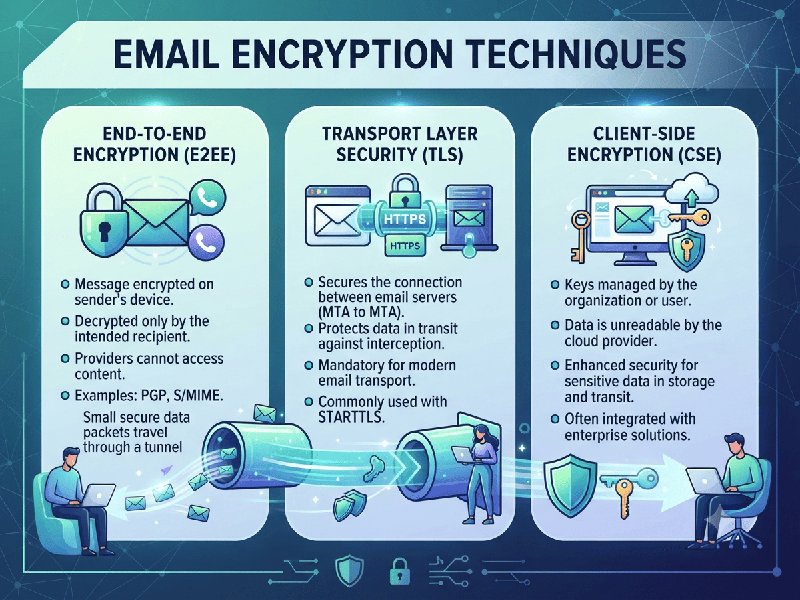
Email Encryption Techniques
Email encryption is a critical practice for protecting
sensitive data from interception and unauthorized access. Generally, email
encryption methods fall into two primary categories: transport-level
encryption (securing the message during transit) and end-to-end
encryption (securing the message content itself).
1. Transport-Level Encryption: TLS
Transport Layer Security (TLS) is the standard method
for protecting emails while they move between email servers (e.g., from your
provider to the recipient's provider).
- How it works: When an email is sent, the
servers perform a "handshake" to establish an encrypted,
authenticated connection. If both servers support TLS, the email is
encrypted during its journey across the internet.
- Strengths: It is largely automated,
requires no setup from the user, and is widely supported by modern email
providers like Gmail and Microsoft 365.
- Limitations: It is not true end-to-end
encryption. Once the email reaches the destination server, it is typically
decrypted and stored in an unencrypted state (unless the recipient’s
mailbox is also encrypted). If the receiving server does not support TLS,
the email may be sent in plain text.
2. End-to-End Encryption (E2EE)
E2EE ensures that only the sender and the intended
recipient can read the message content. Even your email service provider cannot
decrypt the message.
S/MIME (Secure/Multipurpose Internet Mail Extensions)
- How it works: It uses digital certificates
issued by a trusted Certificate Authority (CA) to authenticate the sender
and encrypt the message.
- Best for: Corporate or regulated
environments (finance, healthcare) where identity verification and data
integrity are mandatory.
- Requirement: Both the sender and recipient
must have certificates installed and properly configured.
PGP (Pretty Good Privacy) / OpenPGP
- How it works: It uses a public/private key
pair. You encrypt a message using the recipient’s public key, and
they decrypt it using their secret private key. It also allows for
digital signatures to prove the sender's identity.
- Best for: Privacy-focused individuals,
journalists, and open-source communities.
- Requirement: It can be technically
challenging to set up, as it requires managing keys and ensuring the other
party is also using PGP-compatible software.