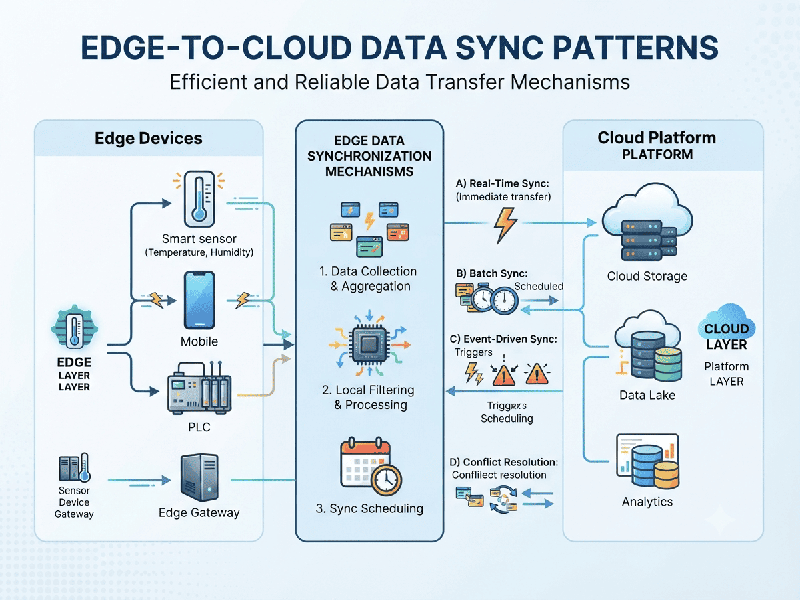
Edge-to-Cloud Data Sync Patterns
Edge-to-Cloud Data Synchronization refers to the design patterns and
architectural strategies used to manage data movement between localized edge
environments (such as IoT devices, retail stores, or factory floors) and
centralized cloud infrastructure.
Because edge locations often face intermittent
connectivity, limited bandwidth, and strict latency requirements, direct,
continuous streaming to the cloud is rarely feasible. Instead, systems rely on
specific synchronization patterns to balance local autonomy with centralized
analytics.
1. Core Edge-to-Cloud Sync Patterns
A. Store-and-Forward (Resilient Sync)
- How it works: Edge devices write raw or
processed data to a local persistent store (such as a local database or
message queue like SQLite or MQTT broker). When network connectivity is
active, the edge client forwards the data to the cloud. If the network
drops, data accumulates locally and is systematically uploaded (flushed)
once connectivity is restored.
- Best for: Environments with unreliable or
intermittent internet access (e.g., remote oil rigs, connected vehicles,
agriculture).
B. Filter, Aggregate, and Project (Bandwidth-Optimized
Sync)
- How it works: Instead of shipping every raw
telemetry point, the edge node cleans, filters (drops noise/duplicates),
and aggregates data locally (e.g., computing hourly averages, rolling
counts, or anomaly flags). Only the summarized insights or explicit
exception events are synchronized upstream.
- Best for: High-frequency data
environments (e.g., thousands of machine vibration sensors per second)
where sending raw data would saturate bandwidth costs.
C. Event-Driven / Pub-Sub Synchronization
- How it works: Uses lightweight messaging
protocols (most notably MQTT or event brokers like Apache Kafka).
Edge components publish data changes to topics only when specific trigger
events occur. Cloud services subscribe to these topics to ingest updates
reactively rather than polling continuously.
- Best for: Real-time alerting systems,
logistics tracking, and state-change tracking where immediate notification
is critical.
D. Bidirectional Master-Data / State Sync
- How it works: Requires synchronization to
flow both ways. The edge pushes transaction logs, user inputs, or local
operational data to the cloud, while the cloud pushes global
configurations, catalog updates, security policies, or freshly trained AI
models back down to the edge. Conflict resolution strategies (e.g.,
Last-Write-Wins, vector clocks, or operational transformation) are
utilized if data diverges.
- Best for: Distributed POS (Point of Sale)
systems, multi-site retail inventory management, and edge AI nodes
receiving model weights.