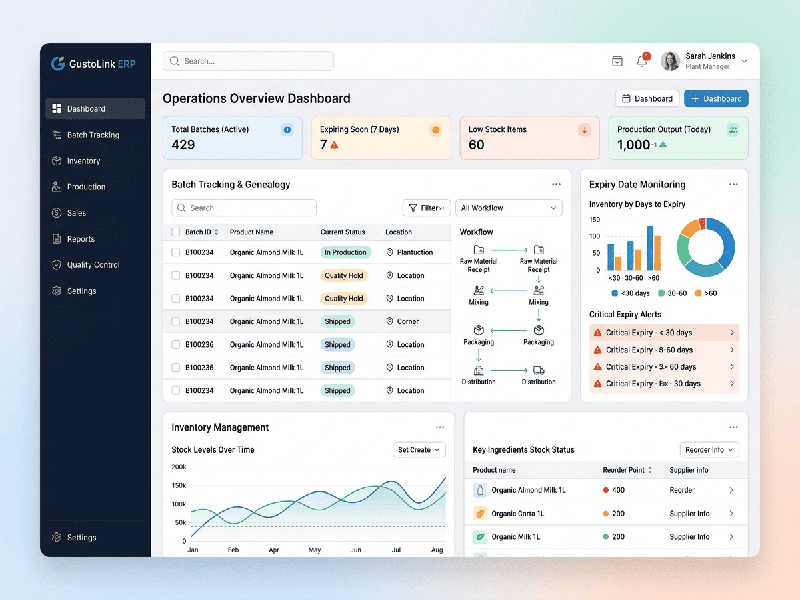
ERP for Food and Beverage Manufacturers: Batch and Expiry Tracking
An Enterprise Resource Planning (ERP) system for Food
and Beverage (F&B) Manufacturers operates under stringent regulatory
standards (such as FDA, FSMA, and HACCP) and ultra-tight profit margins. Unlike
general manufacturing, F&B production involves perishable ingredients,
variable yields, non-discrete units (e.g., liters, kilograms), and strict food
safety mandates.
The operational backbone of an F&B ERP revolves
around Batch (Lot) Management and Expiry Tracking, ensuring
seamless traceability, quality assurance, and minimal inventory waste.
Core Pillars of F&B ERP: Batch & Expiry
Tracking
1. End-to-End Batch Traceability (Bi-Directional)
A food safety issue requires immediate isolation of
affected inventory to limit brand damage and regulatory penalties.
Forward Traceability (Supplier to Customer): Trace a specific batch of raw
ingredients from a supplier through processing, blending, and packaging, down
to every finished goods lot and shipped customer order.
Backward Traceability (Customer to Supplier): Trace a customer complaint or recall
back to the exact production run, machine, shift, and raw ingredient vendor lot
numbers.
Mock Recall Execution: Execute precise mock recalls within
minutes rather than days, generating complete audit reports for regulatory
inspectors.
2. Expiry, Shelf-Life & Expiration Management
Managing perishable inventory prevents costly scrap
and ensures compliance with customer acceptance windows.
FEFO Automation (First-Expired, First-Out): Automatically routes inventory
picking based on expiration dates rather than entry date (FIFO), preventing
stock from spoiling on warehouse shelves.
Dynamic Shelf-Life Calculations: Tracks expiration, sell-by, and
use-by dates dynamically based on storage conditions, processing steps, or
packaging types.
Customer-Specific Acceptance Windows: Prevents shipping lots to retailers
or distributors if the remaining shelf-life falls below their required
threshold (e.g., requiring at least 60 days of remaining shelf-life upon
delivery).
3. Recipe, Formula & Catch Weight Management
F&B manufacturing deals with fluid, variable
ingredients that require precise process control.
Recipe Security & Scaling: Protects proprietary formulas while
allowing scaled production runs based on batch sizes or ingredient
availability.
Catch Weight Processing: Dual-unit tracking (e.g., ordering
or selling by the case, but pricing and managing inventory by exact weight) to
account for natural variations in items like meat, cheese, or produce.
Potency & Yield Adjustment: Adjusts recipe input quantities
automatically based on ingredient potency, moisture levels, or active strength
to maintain product consistency.
4. Quality Control (QC) & Hazard Management
(HACCP)
Quality checks must be integrated directly into batch
workflows rather than managed on standalone spreadsheets.
Quarantine & Hold Workflows: Places incoming ingredient lots or
newly mixed batches into automatic hold status pending lab results or quality
sign-offs.
In-Line Quality Inspections: Triggers mandatory QC checks
(temperature, pH, viscosity, seal integrity) at critical control points (CCPs)
along the production line.
Certificate of Analysis (CoA): Automatically attaches CoAs to
outgoing customer shipments based on batch lab test results.