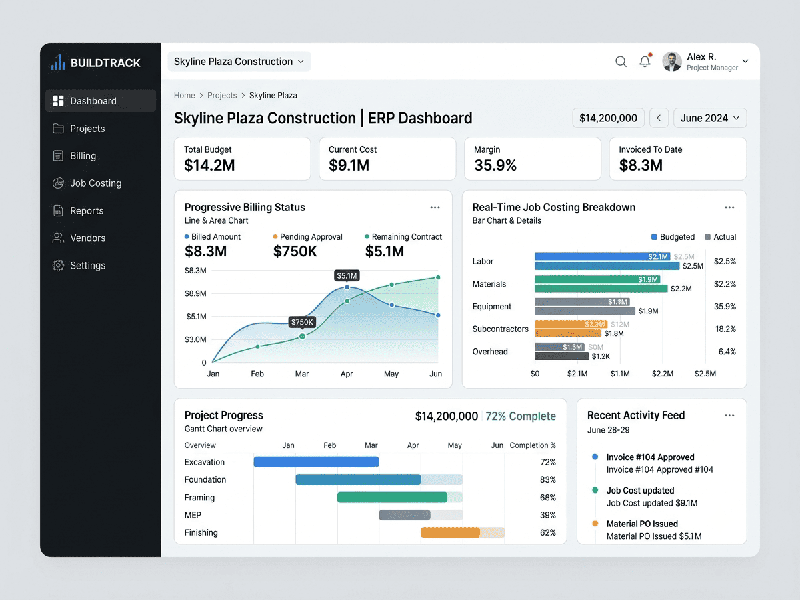
ERP for Construction: Progressive Billing and Job Costing
An Enterprise Resource Planning (ERP) system tailored
for the construction industry operates on a fundamental principle:
managing heavy capital, fluctuating material prices, subcontractor labor, and
multi-stage contracts across remote job sites.
Unlike general manufacturing or professional services,
construction businesses depend entirely on Progressive Billing to
maintain steady cash flow and Job Costing to control granular project
profitability.
Core Pillars of Construction ERP
1. Job Costing (Cost Codes & WBS)
Job costing is the backbone of construction financial
management. It breaks every project down into standard Cost Codes (often using
CSI MasterFormat) across standard cost categories: Labor, Material, Equipment,
Subcontractors, and Overhead.
Budget vs. Actual vs. Committed: Tracks original estimated costs
against actual expenses, purchase orders issued (committed costs), and
subcontracts executed.
Cost to Complete (CTC) & Estimate at Completion
(EAC): Continually
forecasts total estimated costs at completion based on field progress rather
than waiting for invoices to arrive.
Change Order Management: Links field-generated change
requests to cost codes and client contract values, preventing budget slippage
before work begins.
2. Progressive Billing (Progress Invoicing)
Construction projects span months or years, requiring
contractors to bill clients incrementally based on the percentage of work
completed during a specific period.
AIA Billing Standards (G702/G703): Automatically generates standard
industry payment applications, including the Application and Certificate for
Payment (G702) and Continuation Sheet (G703).
Schedule of Values (SOV): Maps contract line items directly to
job cost codes so billed amounts correlate precisely with completed phases.
Retainage Management: Automatically calculates and holds
back withholdings (typically 5–10%) on both owner billings and subcontractor
payments until final completion or project sign-off.
3. Subcontractor & Compliance Management
Managing general contractors (GCs) and trade
subcontractors requires strict compliance checks before payments are released.
Lien Waiver Automation: Generates conditional and
unconditional lien waivers alongside progressive payment releases.
Insurance & Certification Tracking: Prevents payment approval if a
subcontractor’s Certificate of Insurance (COI), workers' compensation, or
safety license has expired.
Certified Payroll: Automatically formats labor hours to meet federal
(Davis-Bacon Act) or local prevailing wage reporting requirements.
4. Equipment, Inventory & Material Management
Construction ERPs track high-value physical assets and
bulk materials across multiple job sites.
Equipment Utilization & Allocation: Tracks heavy equipment usage (hours,
fuel, maintenance) and charges internal rental rates to specific job cost
codes.
Site Materials & Storage: Manages stock levels, field purchase
orders, and inventory transfers between central warehouses and active job
sites.