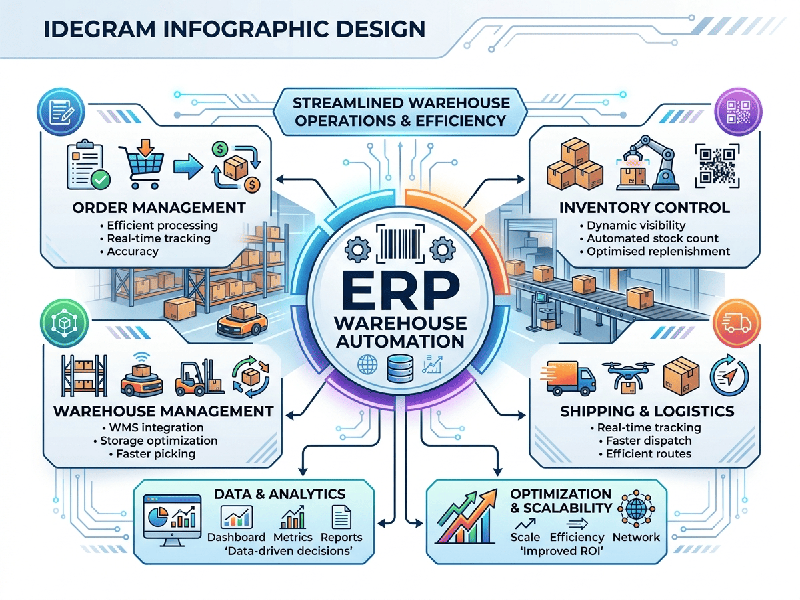
ERP Warehouse Automation
ERP Warehouse Automation integrates Enterprise
Resource Planning (ERP) systems with physical warehouse automation technologies
(hardware like AGVs, AS/RS, and barcode/RFID scanners) and software controls
(WMS/WCS) to streamline storage, picking, packing, and inventory tracking.
Core Components of ERP Warehouse Automation
1. Software Integration Architecture
- ERP System: Functions as the
central database managing purchase orders, sales orders, customer data,
and high-level inventory accounting (e.g., SAP, Oracle NetSuite, Microsoft
Dynamics 365).
- Warehouse Management System
(WMS): Executes daily warehouse operations, slotting strategy, batch
picking logic, and labor management.
- Warehouse Control System (WCS) /
Execution System (WES): Directs real-time physical material handling
equipment (conveyors, sorters, robotics) based on WMS/ERP instructions.
2. Physical & Hardware Automation
- Automated Storage and Retrieval
Systems (AS/RS): Computer-controlled systems that automatically place and
retrieve goods from specific storage locations.
- Autonomous Mobile Robots (AMRs)
& AGVs: Robots that transport goods across the warehouse floor,
reducing manual walking time for warehouse personnel.
- Barcode & RFID Scanning:
Auto-captures inventory movements, updating stock balances in the ERP
system instantly upon receipt or dispatch.
- Automated Sortation &
Conveyors: Directs packages to designated shipping lanes based on ERP
order dispatch instructions.
Process Workflow: ERP-Driven Warehouse Automation
1.
Inbound
Receiving: Goods arrive; barcode/RFID tags are scanned. The WMS validates
shipments against ERP Purchase Orders and automatically assigns optimal storage
bin locations (directed putaway).
2.
Inventory
Tracking: Stock status updates instantly in the ERP general ledger, providing
real-time visibility into available-to-promise (ATP) inventory.
3.
Order
Picking: Customer orders from the ERP trigger picking tasks. Automated systems
(AMRs or Pick-to-Light) guide workers or directly retrieve items via optimal
picking routes.
4.
Packing
& Shipping: Dimensioners measure package sizes, automated labelers apply
shipping documents, and the ERP generates shipping notifications and updates
inventory records.