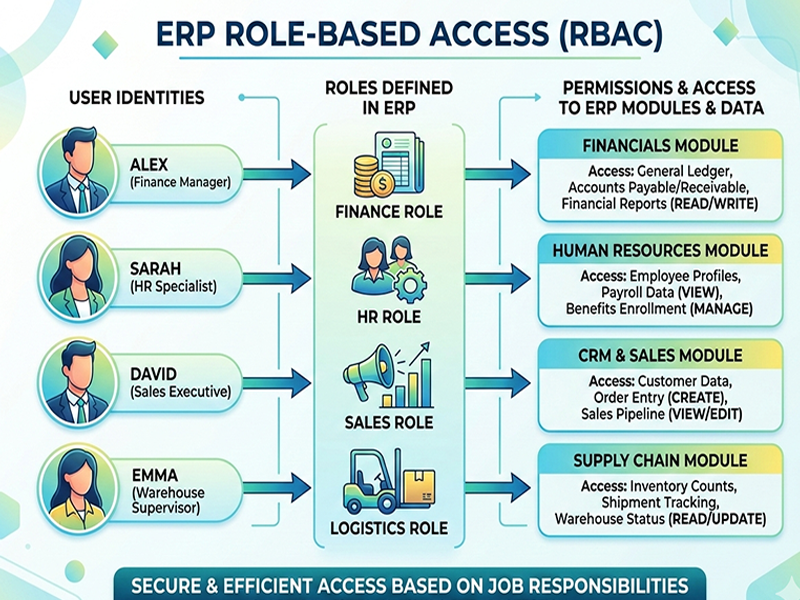
ERP Role-Based Access
In an ERP
(Enterprise Resource Planning) system, Role-Based Access Control (RBAC) is the
standard security framework that ensures employees have access only to the data
and tools necessary for their specific job functions.
Advanced
Trends in 2026
1. The
Zero-Trust Architecture
Modern ERPs
now assume that every access attempt is a potential threat. Even if you are
logged in as an "Admin," the system may require Multi-Factor
Authentication (MFA) or biometric verification before you can export
sensitive financial data or change bank details for vendors.
2.
Segregation of Duties (SoD)
This is a critical fraud-prevention rule. The system is programmed to prevent "Toxic Combinations."
3.
Field-Level & Conditional Access
Permissions
are no longer just about entire modules.
- Field-Level: An HR clerk can see an
employee's name and address but the "Salary" field remains
masked (hidden).
- Just-In-Time (JIT) Access: A Sales Lead might be granted
temporary access to a "Financial Report" only for the duration
of a specific quarterly deal closure.
4.
AI-Driven "Privilege Creep" Detection
In 2026, AI
agents monitor user behavior. If an Inventory Manager suddenly starts trying to
access "Payroll" files at 3:00 AM, the system flags it as an anomaly
and can automatically suspend those permissions until a manager reviews the
alert.
✅ Best Practices for Implementation
- The Principle of Least Privilege
(PoLP): Always
start with zero access and add only what is essential.
- Standardize Profiles: Create "Master Roles"
(e.g., Junior Accountant) so onboarding a new hire takes one click instead
of manual setup.
- Quarterly Reviews: Periodically audit roles to
ensure employees who have changed departments don't still have
"leftover" access from their old jobs.