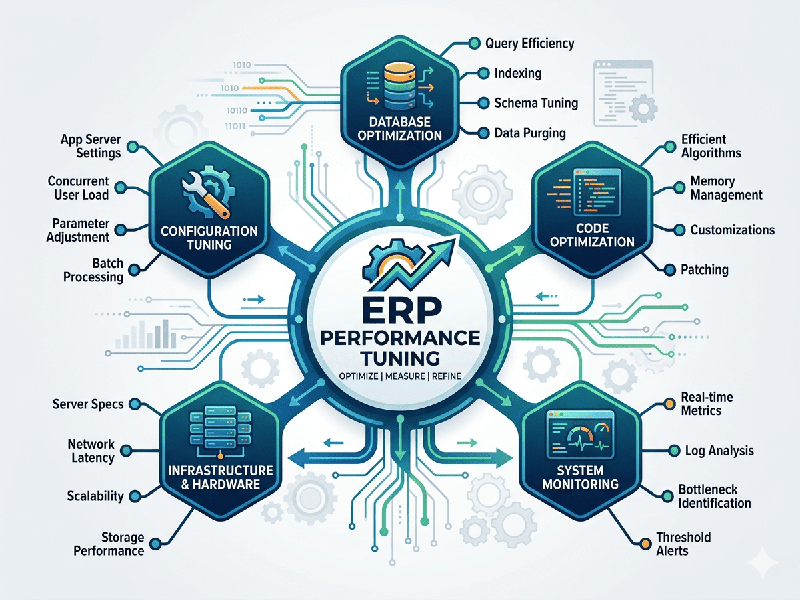
ERP Performance Tuning
ERP (Enterprise Resource Planning) Performance Tuning is the process of optimizing the
software, database, and infrastructure to ensure that business-critical
processes—like real-time inventory updates, financial closing, and order
processing—run at peak efficiency.
1. The Three Layers of Performance Tuning
To fix a "slow" ERP, you must address three
distinct layers:
A. Database Tuning (The Engine)
The database is where 80% of ERP slowdowns occur.
- Indexing: Ensure that frequently queried
tables (like GL_Transactions or Inventory_Master) have correct indexes.
Avoid "over-indexing," which slows down data entry.
- Query Optimization: Identify "Expensive
Queries" that consume high CPU. Modern ERPs use AI to suggest
rewriting SQL code for faster execution.
- Database Statistics: Regularly update statistics so
the database "optimizer" knows the most efficient path to find
data.
- In-Memory Computing: If using systems like SAP
S/4HANA, ensure your hot data (current year) is in-memory while cold
data (historical) is moved to cheaper disk storage.
B. Application & Middleware Tuning
- Concurrent Manager Optimization: Limit the number of heavy
background reports that can run simultaneously during peak business hours.
- Cache Management: Increase application-level
caching for static data like currency codes, country lists, and product
categories to reduce database calls.
- Load Balancing: Ensure traffic is distributed
evenly across multiple application servers so no single server becomes a
"hotspot."
C. Infrastructure & Network Tuning
- Latency Minimization: For global companies, ensure
the application server is physically or "virtually" close to the
users. In 2026, Edge Computing is often used to process local data
before sending it to the central ERP.
- Storage Throughput: Ensure the underlying disks
(NVMe/SSD) have high IOPS (Input/Output Operations Per Second), especially
for transactional-heavy modules like POS or E-commerce.
2. Modern Tuning Strategies (2026 Trends)
- Predictive Scaling: Instead of fixed server sizes,
cloud-based ERPs now use AI to "warm up" and scale resources 30
minutes before a scheduled heavy task, like a month-end payroll
run.
- Observability Pipelines: Using tools like Dynatrace or
Datadog to get "Full Stack" visibility—from a user's click in
India to the database response in a US-West data center.
- Data Archiving (Tiering): Keeping 10 years of data in a
live ERP kills performance. Moving data older than 2 years to a "Data
Lake" can improve system speed by 40–60%.