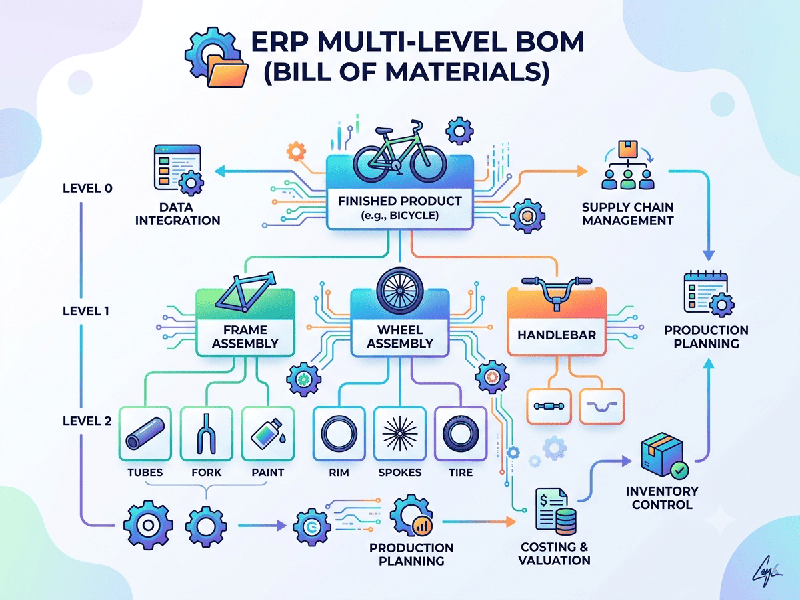
ERP Multi-Level BOM (Bill of Materials)
A Multi-Level Bill of Materials (BOM)—often
called an indented BOM—is a hierarchical product structure that details
every component, sub-assembly, raw material, and sub-component required to
manufacture a finished product.
Unlike a single-level BOM (which only lists immediate
components), a multi-level BOM displays parent-child relationships across
multiple tiers, showing how raw materials build into sub-assemblies before
coming together as the final product.
Key Structure & Hierarchy
A typical multi-level BOM is organized by levels
(Level 0, Level 1, Level 2, etc.):
- Level 0 (End Item): The finished product ready for
sale (e.g., Industrial Air Compressor).
- Level 1 (Sub-Assemblies): Major components built
separately before final assembly (e.g., Motor Unit, Pump
Assembly, Control Panel).
- Level 2 (Child Parts &
Sub-Components):
The individual parts or lower-level assemblies that make up Level 1 (e.g.,
the Control Panel breaks down into a Circuit Board, LCD
Screen, and Wiring Harness).
- Level 3+ (Raw Materials): The raw inputs at the base
level (e.g., Copper Wire, Steel Sheet, Screws).
Why Multi-Level BOMs Matter in ERP Systems
1.
Accurate Material Requirements Planning (MRP): When an ERP triggers production for
a finished good, the multi-level BOM automatically calculates exact
requirements for raw materials across all sub-tiers, preventing material
shortages.
2.
Precise Cost Roll-Up: The ERP calculates the total cost of goods sold (COGS) by summing up raw
material costs, labor, and overhead at each sub-assembly tier up to the final
product.
3.
Streamlined Engineering Change Orders (ECOs): If a component changes, engineers
can update it once at the sub-assembly level rather than rewriting the entire
product structure.
4.
Phantom & Modular BOM Flexibility: ERPs use multi-level structures to handle
"phantom BOMs" (temporary sub-assemblies built and consumed
immediately on the line) and configurable product variants.