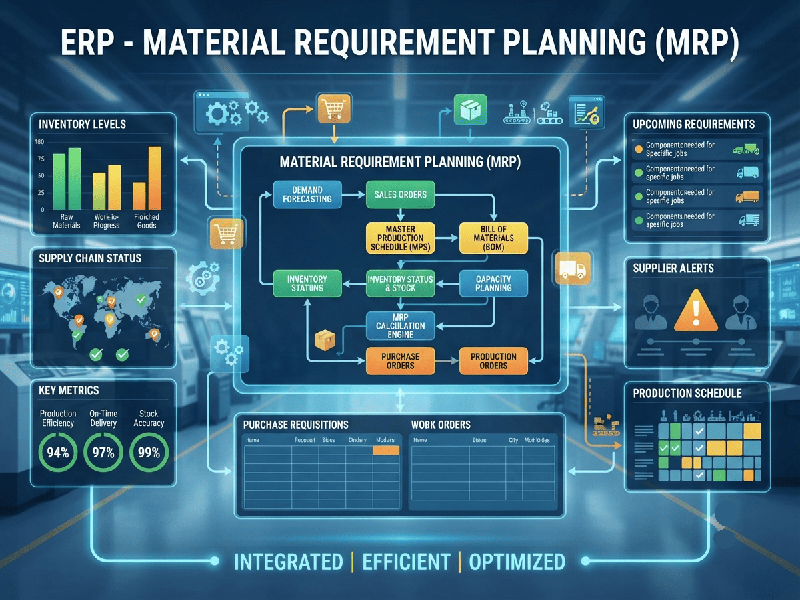
ERP Material Requirement Planning
Material Requirements Planning (MRP) is a core software module and
production management technique used within Enterprise Resource Planning (ERP)
systems. Its primary purpose is to ensure that raw materials and components are
available for production and that finished goods are ready for delivery—all
while keeping inventory levels as low as possible.
Core Objectives of MRP
An MRP system is designed to answer three fundamental
manufacturing questions:
1.
What materials
or components are needed?
2.
How much of
each material is needed?
3.
When are they
needed?
Key Inputs of an ERP MRP System
For MRP to function accurately, it relies on three
primary data inputs:
- Master Production Schedule
(MPS): The plan
that outlines what finished products need to be built, in what quantities,
and by what dates.
- Bill of Materials (BOM): The comprehensive
"recipe" or hierarchy detailing every raw material, subassembly,
and component required to build a finished product.
- Inventory Status Data: Real-time information tracking
what stock is currently available in the warehouse and what items are
already on order or in transit.
The MRP Process Steps
Once the inputs are fed into the ERP system, the MRP
engine runs through a calculated workflow:
1.
Demand Matching: It takes the demand from the MPS and breaks it down using the BOM to
find out exactly which raw components are required.
2.
Netting (Inventory Check): It compares gross requirements against current on-hand
inventory and scheduled receipts to calculate the net shortage (what is
actually missing).
3.
Lot Sizing & Scheduling: It determines optimal order quantities and aligns them with
production timelines.
4.
Action Generation: It automatically generates output recommendations:
o Purchase Orders (POs): Sent to vendors/suppliers to buy raw
materials.
o Work Orders (WOs): Sent to the shop floor to begin
manufacturing subassemblies or finished goods.
o Rescheduling Notices: Alerts if a timeline needs to be
pushed up or delayed based on supply changes.
Key Benefits of ERP-Integrated MRP
- Reduced Inventory Costs: Prevents overstocking and
excess capital tied up in unused raw materials.
- Elimination of Stockouts: Ensures production lines never
grind to a halt due to missing components.
- Streamlined Procurement: Automates the purchasing
process, saving administrative time and reducing human calculation errors.
- Improved Efficiency &
Cross-Departmental Visibility: Because it lives inside an ERP, data flows seamlessly
between sales, procurement, production, and finance.