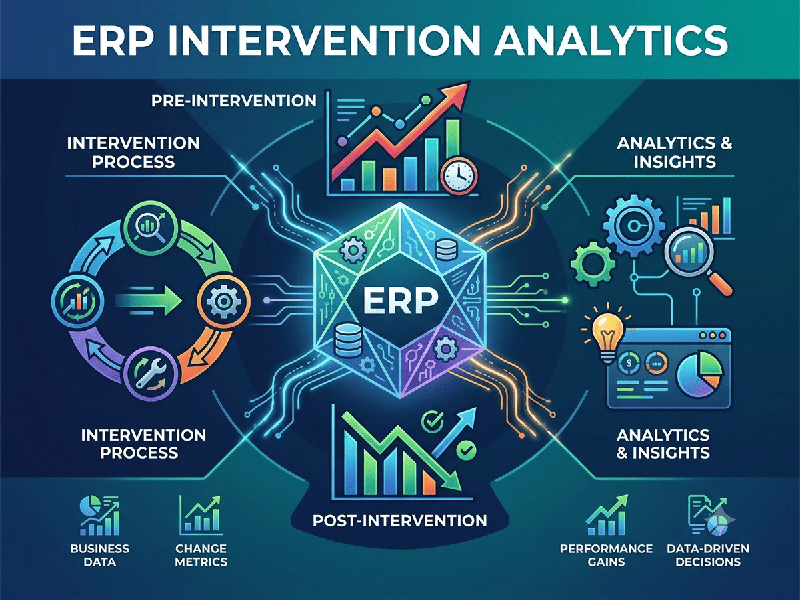
ERP Intervention Analytics
ERP Intervention Analytics refers to the specialized use of
process mining, operational analytics, and machine learning to detect, analyze,
and optimize human interventions within Enterprise Resource Planning (ERP)
systems (e.g., SAP, Oracle, Microsoft Dynamics).
In a fully automated system, data flows seamlessly
through standard business workflows ("happy paths"). Intervention
analytics isolates every instance where a human worker must manually
intervene—such as overriding prices, re-entering data, approving exceptions, or
resolving failed transactions—to quantify the cost of inefficiency, prevent
compliance risks, and drive continuous process automation.
Core Focus Areas & Use Cases
- Process Mining & Friction
Mapping:
Reconstructs step-by-step transaction logs from ERP
databases to visualize real-world workflows versus theoretical models,
identifying exact bottleneck locations where manual fixes occur.
- Rework & Exception Tracking:
Measures the frequency and root cause of manual
updates to master data, invoice adjustments, order-hold overrides, or purchase
order changes.
- Audit & Compliance Risk
Mitigation:
Monitors segregation-of-duties (SoD) violations,
unauthorized price overrides, and manual journal entries to flag potential
fraud, compliance drift, or internal control failures.
- Automation Readiness Assessment:
Identifies high-volume, repetitive manual intervention
patterns to prioritize targets for Robotic Process Automation (RPA) or
API-first integration projects.
1.Ingest Event Logs & Change Data Capture:Extract granular transactional
histories.
Extract change-log tables, user action logs, and
timestamped transaction records directly from ERP system modules (e.g.,
Order-to-Cash, Procure-to-Pay).
2.Map Process Variants & Deviations:Reconstruct real-world transactional
paths.
Process mining algorithms map actual execution paths
against baseline "happy paths" to isolate every instance of manual
data entry, hold removal, or price adjustment.
3.Calculate Financial & Time Impact:Quantify processing delays and
operational overhead.
Assign labor costs, cycle-time delays, and error rates
to each intervention category to quantify the true operational expense of
manual workarounds.
4.Apply Automation & Governance Controls:Remediate root causes and implement
safeguards.
Redesign broken process steps, fix upstream master
data defects, or deploy targeted RPA bots to eliminate non-value-added human
interventions permanently.