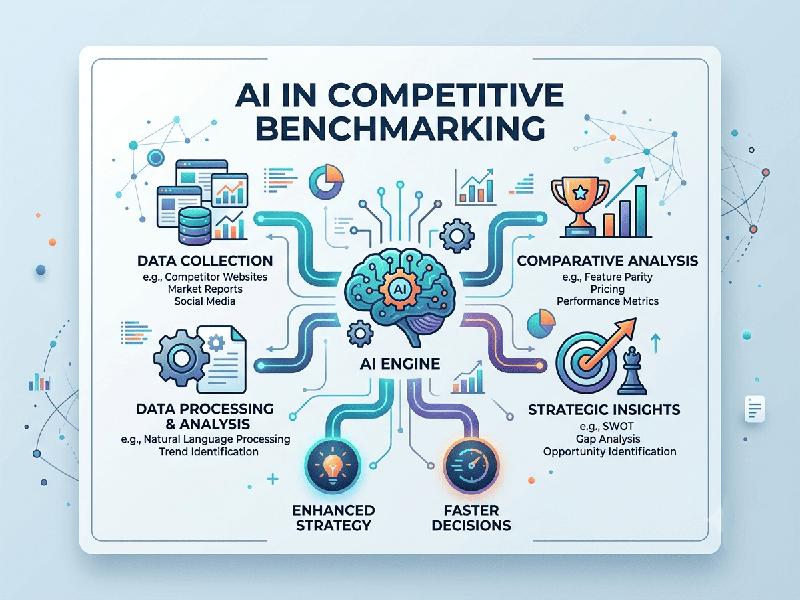
AI in Competitive Benchmarking
AI in Competitive Benchmarking refers to using artificial
intelligence technologies—such as machine learning (ML), natural language
processing (NLP), and predictive analytics—to automate, analyze, and compare an
organization’s performance, products, pricing, and marketing strategies against
direct competitors and industry standards.
Key Applications & Use Cases
- Dynamic Pricing & Revenue
Intelligence
AI models continuously track competitor pricing
models, promotions, and inventory levels in real time to suggest or execute
automated price adjustments.
- Social Sentiment & Customer
Review Mining
NLP algorithms analyze thousands of customer reviews,
social media mentions, and support tickets to reveal competitors' weak points
and product gaps.
- Generative Engine Optimization
(GEO) & AI Share of Voice
Measures how often AI search engines (like ChatGPT,
Gemini, and Perplexity) recommend your brand versus your competitors for
non-branded intent queries.
- Content & Search Marketing
Intelligence
AI tracks competitor keyword movements, ad spends,
campaign visuals, and messaging shifts, providing predictive insights on which
strategies are driving traffic.
- Operational & Financial
Benchmarking
Evaluates financial metrics, supply chain efficiency,
and operational costs against industry peers to pinpoint resource allocation
issues.
Implementation Steps
1.
Define Core Metrics: Select specific KPIs to benchmark (e.g., Customer Acquisition Cost,
pricing parity, share of search voice, or feature coverage).
2.
Select AI Intelligence Tools: Implement tools tailored to your operational area (e.g.,
Semrush/Ahrefs for SEO intelligence, Crayon/Klue for general competitive
intelligence, or dynamic pricing tools).
3.
Establish Data Governance: Ensure clean data inputs to prevent model hallucinations,
bias, or privacy breaches.
4.
Automate Action Triggers: Link benchmarking outputs directly to strategic workflows,
such as automated ad adjustments or product roadmap prioritization.