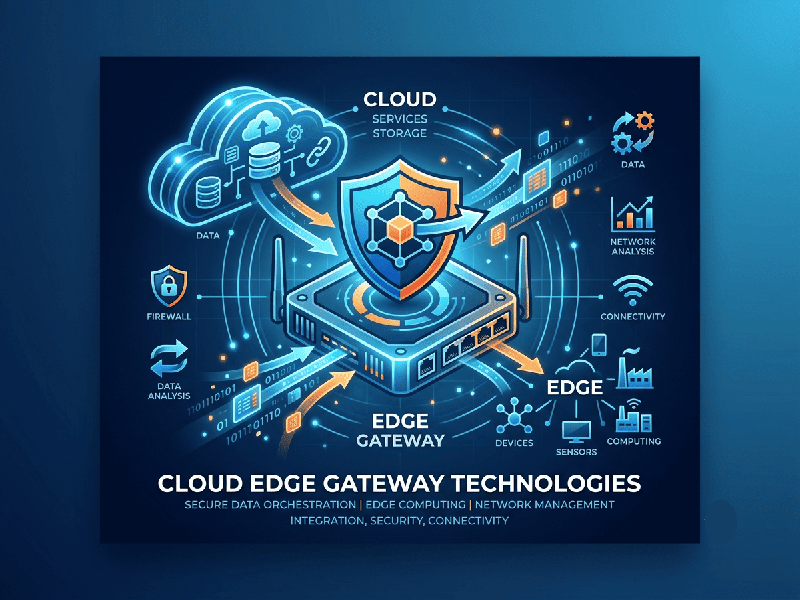
Cloud Edge Gateway Technologies
Cloud Edge Gateway Technologies serve as the critical bridge
connecting localized physical devices (such as IoT sensors, factory equipment,
and branch devices) with centralized cloud environments. By processing,
filtering, and securing data locally at the network perimeter before forwarding
relevant payloads to the cloud, edge gateways minimize latency, reduce
bandwidth overhead, and maintain offline resilience.
Protocol
Translation & Ingestion: Converts legacy operational technology (OT)
protocols (e.g., OPC UA, Modbus, BACnet) into cloud-friendly web protocols
(e.g., MQTT, HTTP/2, gRPC).
Local Data
Aggregation & Filtering: Filters noisy raw telemetry at the edge,
sending only anomalous events, summaries, or actionable insights upstream to
lower WAN costs.
Edge
Compute & AI Inference: Runs containerized applications (such as
lightweight Kubernetes clusters) to perform real-time computer vision,
predictive maintenance, and local machine learning inference near the data
source.
Store-and-Forward
Resilience: Buffers operations locally during network disruptions or
intermittent connectivity, syncing data seamlessly once the cloud link is
restored.
Zero Trust
Security: Acts as an execution boundary enforcing mutual TLS (mTLS),
hardware-level root of trust, device authentication, and network segmentation.
Primary Industry Applications
- Smart Manufacturing (IIoT): Connects Programmable Logic
Controllers (PLCs) directly to cloud dashboards while computing Overall
Equipment Effectiveness (OEE) metrics on-site.
- Retail & Branch Operations: Operates point-of-sale (POS)
systems during internet outages, managing local computer vision streams
for inventory and security.
- Healthcare Technology: Routes medical device telemetry
through HIPAA/privacy-compliant local boundaries, generating real-time
emergency alerts before sending encrypted records to clinical clouds.
- Energy & Smart Buildings: Translates HVAC, lighting, and
sensor protocols to optimize energy management systems locally without
relying on constant cloud connection.
Implementation Workflow
1.
Hardware & OS Provisioning: Deploy hardened edge gateway hardware equipped with secure
enclaves (e.g., TPM modules) and minimal Linux operating systems.
2.
Container Runtime Setup: Install lightweight container orchestration frameworks
(e.g., K3s, MicroK8s, Docker) to host modular workloads.
3.
Protocol Driver Deployment: Configure industrial and IoT protocol adapters (e.g., MQTT
brokers, OPC UA drivers) to talk to downstream endpoints.
4.
Security & Data Pipelines: Enforce Zero Trust boundaries, mTLS certificate rotation,
and establish localized store-and-forward buffers for cloud sync.