ERP Customization Pros & Cons
In the context of scaling a business like Agrived
Foods, the choice between ERP configuration and customization is one of the
most critical technical decisions you will make. By 2026, the industry
consensus has shifted heavily toward "standardization first" to
ensure long-term agility.
Configuration vs. Customization: The Core Difference
- Configuration is like adjusting the settings
on a smartphone (e.g., changing workflows, user roles, or report
templates). It stays within the software’s intended framework.
- Customization is like modifying the phone’s
hardware or operating system code. It requires writing new code to force
the system to perform functions it wasn’t built for.
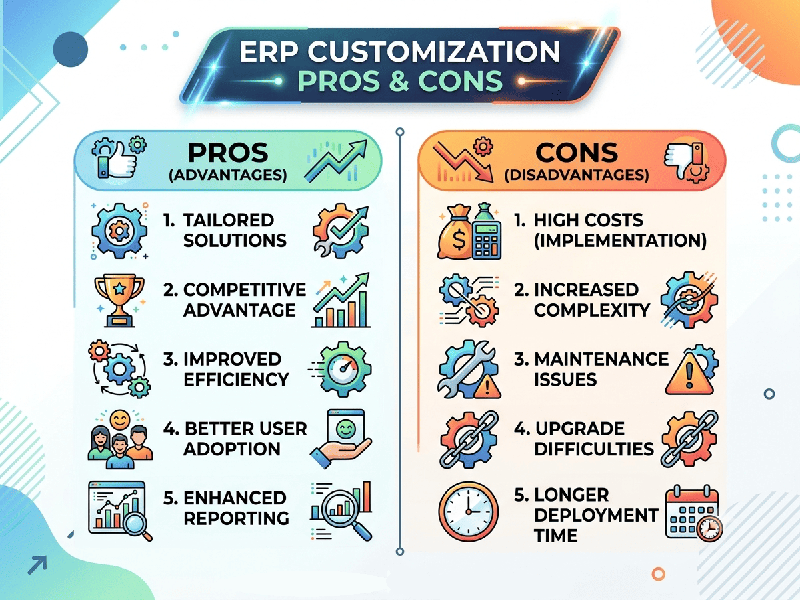
The Strategic "Pros & Cons"
Customization: The Strategic Risks
- The "Upgrade Trap": The biggest disadvantage is
that custom code often "breaks" when the ERP provider releases a
major update. You then face an expensive cycle of refactoring your custom
code to make it compatible with the new version.
- Technical Debt: Every line of custom code adds
complexity. Over time, you become dependent on the specific developers who
built it, making it harder to troubleshoot issues or switch partners.
- Hidden Costs: The initial build is just the
beginning. You are responsible for testing, securing, and maintaining that
code for the life of the system.
Customization: The Strategic Benefits
- Competitive Edge: If you have a highly unique
process (e.g., a proprietary traceability method for organic food that
gives you a distinct market advantage), customization can bake that
"secret sauce" directly into your digital backbone.
- Niche Compliance: Sometimes standard ERPs cannot
handle specific local regulatory requirements or industry-specific
certifications, making customization a "necessary evil" to stay
compliant.
Recommended 2026 Best Practices for Agrived Foods
1.
Adopt the "Configuration-First" Rule: Aim for 80% configuration and 20%
customization. If a process doesn't fit the ERP, challenge the process
before you change the code. Often, it is cheaper to adapt your business
workflow to industry best practices than to adapt the software to a suboptimal
manual process.
2.
Use "Composability": Instead of modifying the ERP core, use APIs to connect the
ERP to "best-of-breed" external tools. For example, if your ERP lacks
advanced cold-chain tracking, don't customize the ERP; integrate an IoT-based
cold chain platform via an API.
3.
Audit Before You Build: Before approving any customization, run a Cost-to-Benefit
Analysis. Does this modification save more in annual operational efficiency
(measured in ₹) than it costs to build and maintain annually? If the
answer is no, skip it.
4.
Prioritize "Low-Code" Extensions: Modern ERPs (like Oracle NetSuite or
SAP S/4HANA) provide low-code/no-code extension frameworks. These are
"safe" customizations that live outside the core code, ensuring they
survive system upgrades.