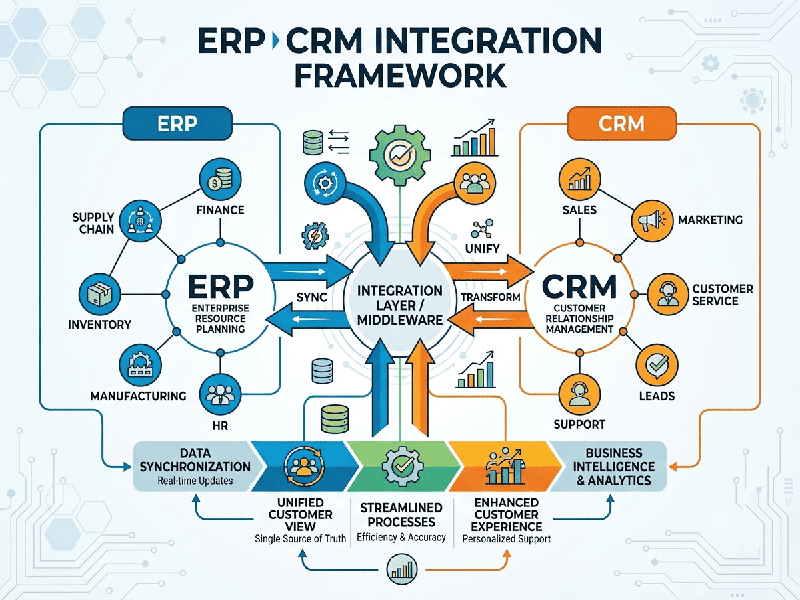
ERP CRM Integration Framework
An effective ERP-CRM integration framework bridges the
gap between front-office customer engagement and back-office operations. By
synchronizing data across these platforms, organizations eliminate data silos,
automate the quote-to-cash process, and achieve a unified 360-degree view of
the customer.
1. Architectural Integration Models
Selecting the right integration architecture dictates
the scalability and reliability of the data flow.
- Point-to-Point (P2P): A direct, custom-coded
connection between the CRM and ERP. While cost-effective for very simple,
low-volume environments, it becomes brittle as business logic scales and
often causes ERP performance tuning issues due to tight coupling.
- Integration Platform as a
Service (iPaaS):
The industry standard for enterprise architecture. Utilizing middleware
hosted on scalable cloud infrastructure (like GCP or Azure) allows for
asynchronous data routing, data mapping, and queuing without overloading
the core ERP database.
- Event-Driven / API-Led
Connectivity: Microservices
architecture where systems communicate via REST or SOAP APIs based on
real-time triggers. This is essential when embedding AI/ML applications
into the pipeline, as it allows external models to monitor data streams
(e.g., predicting churn or forecasting inventory demand) without
disrupting the core integration.
2. Implementation Phasing
Deploying the integration in structured phases
minimizes operational risk and ensures data integrity.
1.
Data Cleansing & Mapping: Before connecting the systems, deduplicate records in both
databases. Establish a clear schema mapping document (e.g., matching the CRM's
Account_Name field to the ERP's Customer_ID).
2.
Infrastructure Setup & Security: Deploy the middleware environment. Ensure robust
authentication (OAuth 2.0) and encrypt data in transit.
3.
Pilot Testing (Order-to-Cash): Test the most critical workflow first. Push a test
opportunity from the CRM, verify it creates a sales order in the ERP, triggers
fulfillment, and returns an invoice status back to the CRM.
4.
AI Model Monitoring & Analytics Deployment: Once data is flowing seamlessly,
deploy AI/ML monitoring tools across the middleware to detect anomalies in
order volumes or synchronization failures before they impact the business.
5.
Go-Live & Performance Tuning: Monitor API limits, payload sizes, and database lockups.
Continuous ERP performance tuning is required as transaction volumes scale.
3. Measuring ROI and Impact
A mature integration framework should yield measurable
operational improvements:
- Reduced Order Cycle Time: Eliminating manual data entry
between systems accelerates fulfillment.
- Improved Accuracy: Removing human error from the
order-taking process reduces costly returns and billing mistakes.
- Direct Cost Savings: Automating manual
administrative overhead can rapidly generate efficiency savings ranging
from ₹5,00,000 to ₹25,00,000+ annually, depending on the scale of the
operations and previous manual headcount.