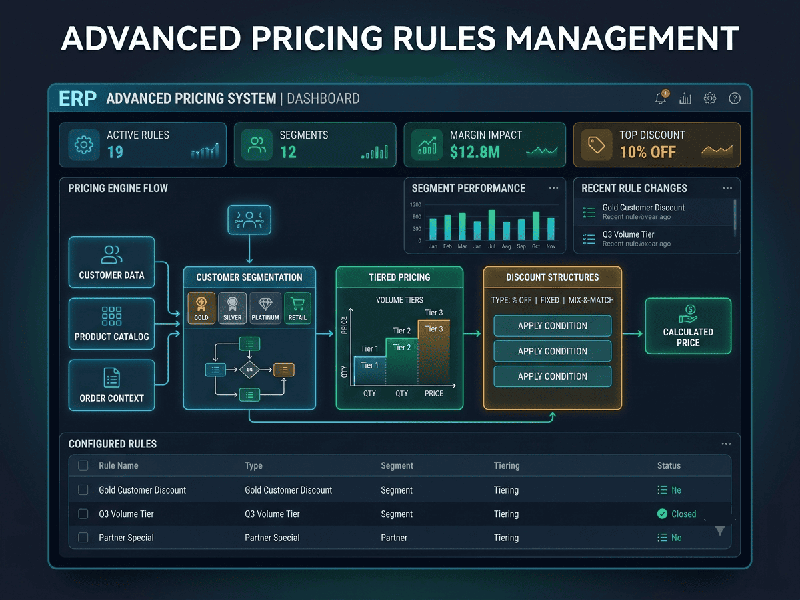
ERP Advanced Pricing Rules
ERP Advanced Pricing Rules refer to automated engines within Enterprise Resource Planning (ERP) systems (such as Oracle, SAP, NetSuite, ERPNext, Microsoft Dynamics) designed to dynamically calculate final selling prices, discounts, surcharges, and promotions during order entry.
Instead of relying on static price lists, Advanced Pricing Rules allow businesses to handle complex, multi-tiered B2B and B2C commercial terms automatically.
Core Building Blocks
Most ERP pricing engines evaluate orders based on four primary components:
Qualifiers / Eligibility Rules: Define who gets the specific price or discount (e.g., Customer Group, Geography, Order Type, Sales Channel).
Pricing Attributes: Define what conditions trigger the rule (e.g., Item Category, Minimum Order Quantity, Payment Terms, Delivery Date).
Modifiers / Price Adjustments: Specify how the price is adjusted—such as percentage discounts, fixed-amount markups, surcharges, or free items.
Formulas: Dynamic mathematical expressions used when prices depend on external cost factors, market indices, or bundled products.
How the ERP Processing Engine Works
Trigger: A line item is added to a Sales Order or Quote.
Lookup: The engine queries active Price Lists for the standard base price.
Evaluation: The system checks active Qualifiers to identify applicable rules for the specific customer and item combination.
Precedence / Rule Priority: If multiple rules apply (e.g., Customer Discount + Promo Discount), the system uses defined priority rankings or stacking rules to resolve conflicts.
Execution: The engine applies the calculated Modifiers/Formulas to output the final unit price, discount amount, and net line total.