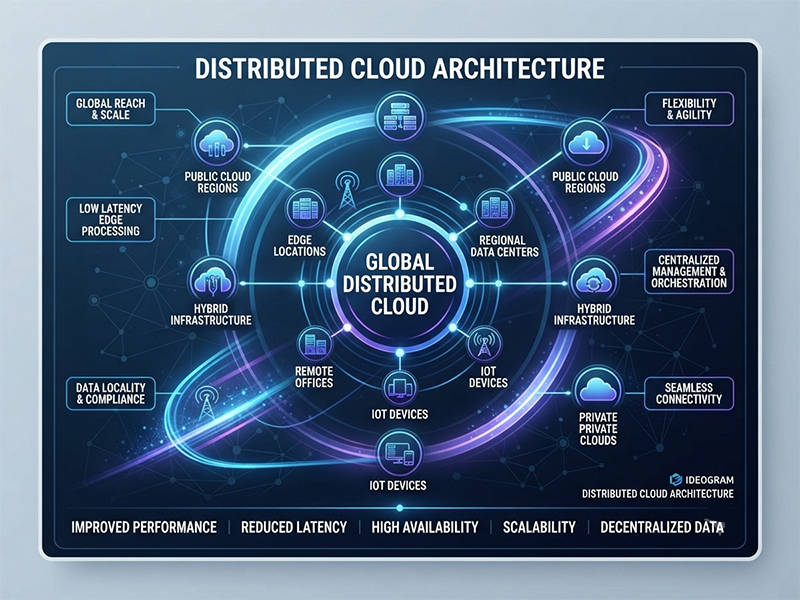
Distributed Cloud Architecture
Distributed cloud architecture is a cloud computing model where
services originating from a public cloud are distributed to multiple different
physical locations—such as on-premises data centers, edge devices, or other
public clouds—while remaining centrally managed, controlled, and updated by the
primary cloud provider.
Unlike traditional centralized cloud models (where all
workloads run in massive, centralized hyperscale data centers), distributed
cloud pushes infrastructure and services closer to where data is generated and
consumed.
Key Characteristics & Components
- Centralized Control Plane: Even though infrastructure is
scattered across different physical sites, everything is managed from a
single, unified control panel. Security policies, updates, and governance
are handled centrally.
- Edge Computing Integration: It integrates seamlessly with
edge locations, IoT devices, and local servers to process time-sensitive
data locally.
- Multi-Location Consistency: Developers use the same APIs,
development tools, and containers across all distributed locations,
ensuring architectural consistency.
- Local Data Residency: By keeping data processing
localized, organizations can comply with strict regional data sovereignty
and privacy regulations.
Core Benefits of Distributed Cloud
- Ultra-Low Latency: Processing data physically
closer to the end-user or IoT device drastically reduces network
round-trip time, making real-time applications (like autonomous driving or
industrial automation) viable.
- Enhanced Data Sovereignty &
Compliance:
Financial institutions, healthcare providers, and government agencies can
keep sensitive data within specific geographic borders or local
jurisdictions.
- High Availability &
Resilience: If
a primary connection to a public cloud region fails, localized nodes can
continue operating autonomously, ensuring business continuity.
- Optimized Bandwidth Costs: Instead of transmitting raw,
high-volume telemetry or video data back to a central cloud, data is
filtered and processed locally, saving significant network bandwidth
expenses.
Real-World Use Cases
- Financial Services: Ensuring ultra-low latency for
high-frequency algorithmic trading while meeting strict local banking
regulations.
- Retail & Smart Logistics: Running localized inventory
systems and point-of-sale (POS) apps that remain functional even during
temporary internet outages.
- Telecommunications: Powering 5G network slicing and
multi-access edge computing (MEC) for instantaneous mobile data handling.