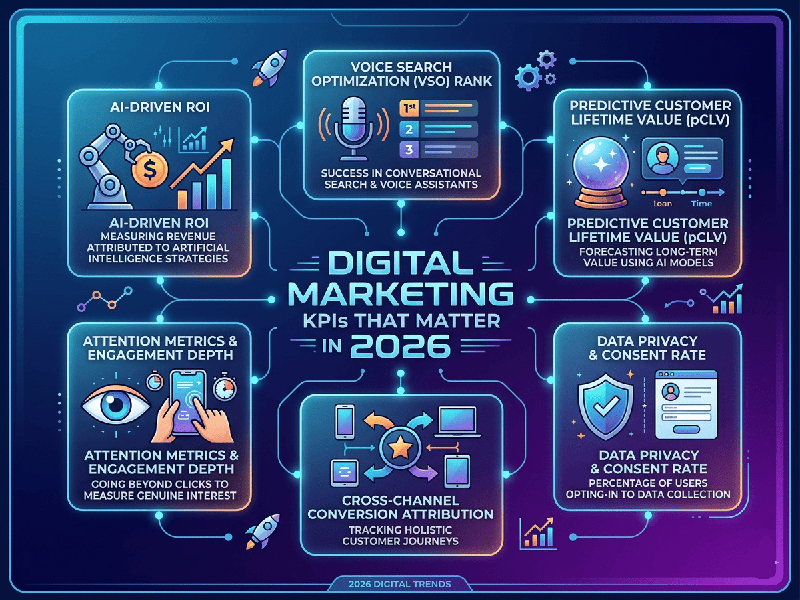
Digital Marketing KPIs That Matter in 2026
The era of "vanity metrics" (like raw clicks or
impressions) has largely ended. Marketing leaders are under increasing pressure
to demonstrate capital efficiency and revenue contribution to the
C-suite.
To succeed this year, you should shift your focus from
isolated channel performance to a unified revenue-impact model. Here are
the key performance indicators (KPIs) that matter most in the current
landscape:
1. Revenue & Capital Efficiency KPIs
These metrics tell the CFO whether marketing is an investment
or a cost center.
- Customer Acquisition Cost (CAC)
Payback Period:
The time required to recover the cost of acquiring a customer. In 2026,
aiming for under 18 months is a key benchmark for financial health.
- LTV:CAC Ratio: The gold standard for
sustainable growth. A ratio of 3:1 is healthy; 5:1 suggests
you could be growing faster by investing more.
- Marketing ROI: The total profit generated
relative to your marketing spend.
- Brand-Assisted Deal Size: The difference in average deal
value between accounts that engaged with your brand (content, thought
leadership) vs. those that didn't. This proves that brand authority is a
performance multiplier.
2. Pipeline & Quality Metrics
Traditional lead counts are misleading; high-intent pipeline
value is the focus.
- Pipeline Velocity: How fast opportunities move
through the sales cycle. Marketing influences this by providing the right
content at the right time to clear buyer objections.
- Cost per Pipeline Dollar: A shift from "Cost per
Lead." It measures marketing spend divided by the total value of the
pipeline created, ensuring you prioritize quality over volume.
- Buying Group Engagement Score: In B2B, buying decisions are
committee-based. This metric tracks the % of the buying committee that has
engaged with your content. (30%+ is considered a strong signal).
3. AI & Search Discovery KPIs
With AI Overviews and answer engines (like Perplexity or
ChatGPT) becoming primary discovery channels, traditional ranking metrics are
evolving.
- AI Citation Rate: How often your brand or content
is cited in AI-generated summaries.
- Branded Search Volume: Your leading indicator for
future performance. If brand search volume grows, your organic and paid
efficiency naturally improves 60–90 days later.
- Intent Surge Lag: The time between a visitor
showing "peak intent" (e.g., visiting pricing or competitor
comparison pages) and sales engagement. Shorter is better.