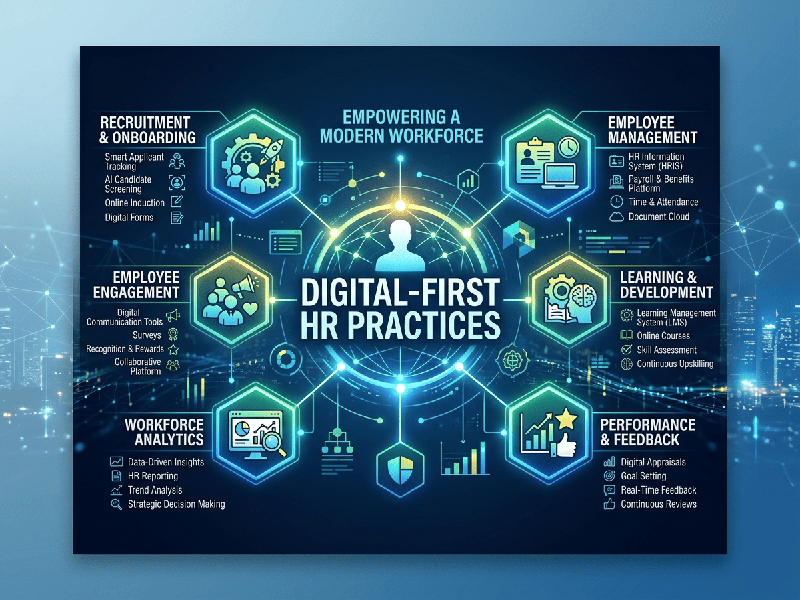
Digital-First HR Practices
Digital-first HR practices represent a shift from using
technology as a secondary tool to making it the core foundation of how a
company manages its people. In 2026, this has evolved beyond simple
"paperless" offices into Autonomous HR, where AI and
integrated data drive the entire employee lifecycle.
1. Core Components of Digital-First HR
To be truly "digital-first," an organization moves
away from siloed spreadsheets and toward a Unified Data Architecture.
- Self-Service Ecosystems: Employees manage their own
leave, payroll, and benefits via mobile-first portals, removing HR as a
middleman for administrative tasks.
- Predictive People Analytics: Instead of looking at what
happened (descriptive), HR uses AI to predict turnover risks, identify
emerging skill gaps, and optimize workforce planning.
- Hyper-Personalization: Digital platforms offer
"Amazon-like" experiences—tailored benefits packages,
personalized career paths, and adaptive learning journeys based on an
employee's specific goals.
2. Key Trends and Practices for 2026
AI Orchestration & Automation
AI is no longer just a chatbot; it acts as an orchestrator.
For example, when a new project is logged in a Project Management tool, the HR
system can automatically identify internal employees with matching skills and
suggest them for the team.
Holistic Health Integration
Well-being has moved into the digital realm. Tools now
monitor "burnout signals"—such as erratic working hours or decreased
engagement on collaboration platforms—and trigger proactive support prompts or
mandatory "digital detox" blocks.
Ethical Governance & Risk Management
As HR becomes more automated, 2026 practices prioritize Algorithmic
Fairness. Companies now perform regular audits on their AI hiring tools to
ensure no bias is being introduced against specific demographics.
3. Measuring Success (KPIs)
To ensure digital transformation provides a return on
investment (ROI), HR teams track:
- Process Cycle Time: How much faster is onboarding
or leave approval?
- Skills Index: Is the organization’s total
"skill score" increasing due to personalized learning?
- Employee Sentiment Score: Real-time data from "pulse
surveys" rather than annual engagement scores.
- Turnover Savings: The cost saved by predicting
and preventing high-performer attrition.