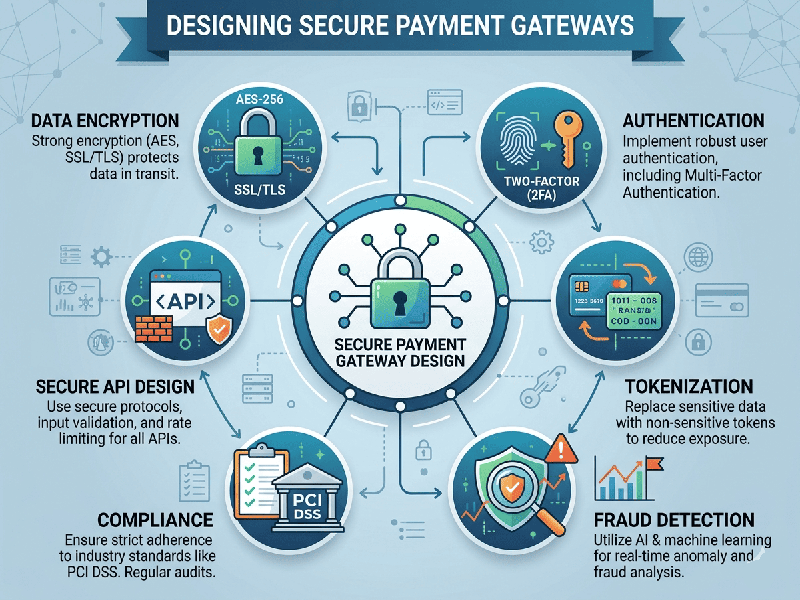
Designing Secure Payment Gateways
Designing a secure payment gateway requires a multi-layered
defense strategy that balances strict security protocols with a frictionless
user experience. In the modern fintech landscape, security is not just about
encryption; it is about establishing a "Chain of Trust" from the
moment a user enters their card details until the funds are settled.
1. Core Security Architecture
A secure gateway must adhere to several industry-standard
architectural principles to protect sensitive financial data.
- PCI-DSS Compliance: The Payment Card Industry Data
Security Standard is the baseline requirement. It mandates a secure
network, protected cardholder data, and regular monitoring of systems.
- Tokenization: This is the most critical
defense. Instead of storing the Primary Account Number (PAN), the gateway
replaces it with a unique, randomly generated "token." Even if a
database is breached, the tokens are useless to hackers.
- End-to-End Encryption (E2EE): Data must be encrypted at the
point of entry (the browser or app) and remain encrypted until it reaches
the secure processing environment.
2. Authentication and Verification
Verification steps ensure that the person initiating the
transaction is the actual owner of the payment instrument.
- 3D Secure 2.0 (3DS2): This provides an extra layer of
authentication (like a biometric check or a one-time password) without
necessarily interrupting the checkout flow, using data sharing to verify
identity.
- AVS (Address Verification
System): Compares
the billing address provided by the user with the address on file with the
credit card issuer.
- CVV/CVC Checks: Ensuring the physical card is
present by requiring the 3-digit code on the back.
3. The Transaction Flow
Understanding how a secure transaction moves through various
entities is vital for identifying potential points of failure.
1.
Initiation:
The user enters card details on a secure, TLS-encrypted form.
2.
Authorization Request: The gateway encrypts the data and sends it to the acquiring
bank (the merchant's bank).
3.
Authentication:
The acquiring bank forwards the request to the issuing bank (the customer's
bank) via card networks (Visa/Mastercard).
4.
Verification:
The issuing bank checks for fraud and sufficient funds.
5.
Response: The
"Approved" or "Declined" status is sent back through the
gateway to the merchant.
4. Fraud Prevention & Risk Management
Modern gateways utilize real-time analysis to stop fraudulent
attempts before they are processed.
- Velocity Checks: Monitoring for
"carding" attacks, where a bot attempts hundreds of small
transactions in a few minutes to see which cards are active.
- Geolocation & IP Filtering: Flagging transactions that
originate from high-risk regions or IPs associated with previous fraud.
- Behavioral Analytics: Using machine learning to
detect if a transaction deviates from a user’s typical spending habits.