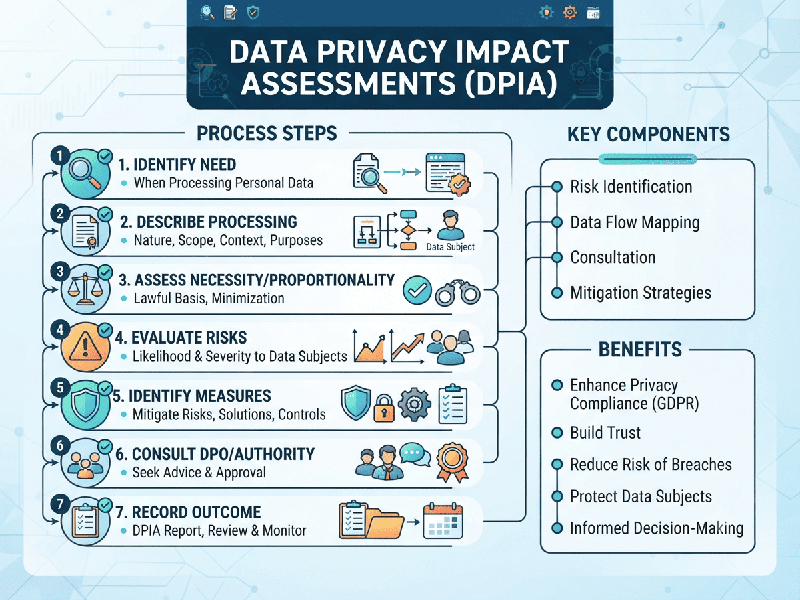
Data Privacy Impact Assessments
A Data Privacy Impact Assessment (DPIA)—often
referred to as a Privacy Impact Assessment (PIA)—is a structured
risk-assessment process used to identify, evaluate, and mitigate privacy risks
associated with data processing activities, new technologies, products, or
business projects.
Under major privacy frameworks like the EU GDPR,
CCPA/CPRA, and India's Digital Personal Data Protection (DPDP) Act, conducting
a DPIA is not just a best practice; it is frequently a legal mandate before
handling high-risk personal data.
1. When is a DPIA Required?
Organizations typically trigger a DPIA when launching
initiatives that introduce high risks to individuals' privacy rights,
including:
- Large-scale processing of
sensitive personal data (e.g., financial records, health information,
biometric data).
- Systematic and extensive
profiling or automated decision-making that produces legal or similarly
significant effects.
- Public-scale monitoring or
surveillance of publicly accessible areas (e.g., CCTV networks, IoT
tracking).
- Deploying new, disruptive
technologies (e.g., generative AI models, facial recognition software, or
cross-border data transfer mechanisms).
2. Core Steps of the DPIA Lifecycle
- Step 1: Project Description
& Mapping
o Document the lifecycle of the data:
What personal data is collected? Where does it come from? How is it stored,
processed, and shared?
o Establish the lawfulness,
necessity, and proportionality of the project—proving why the data
collection is genuinely required to achieve the business goal.
- Step 2: Stakeholder &
Consultation Process
o Involve cross-functional teams
including legal, IT/security, product management, and your Data Protection
Officer (DPO) to uncover blind spots.
- Step 3: Risk Assessment &
Threat Modeling
o Identify potential privacy threats
(e.g., unauthorized access, data leaks, function creep, unlawful profiling, or
lack of user consent mechanisms).
o Evaluate risks based on two metrics: Severity
of the potential harm to individuals and Likelihood of occurrence.
- Step 4: Mitigation &
Remediation Planning
o Formulate actionable controls to
eliminate or reduce identified risks. Examples include:
§ Implementing end-to-end encryption or
pseudonymization.
§ Enforcing strict role-based access
control (RBAC) and data minimization.
§ Adding clear, granular user consent
prompts and data deletion workflows.
- Step 5: Sign-Off, Documentation,
& Review
o Obtain formal approval from
compliance officers or the DPO before project deployment.
o Treat the DPIA as a living document;
schedule regular re-evaluations whenever the system architecture or data
processing scope significantly changes.
3. Business Benefits of a Robust DPIA
- Regulatory Compliance &
Penalty Avoidance: Protects the organization from massive statutory fines and legal
liabilities associated with non-compliance.
- Trust and Brand Equity: Demonstrates to customers,
partners, and regulators that privacy is embedded by design, fostering
long-term brand loyalty.
- Early Vulnerability Mitigation: Uncovers architectural security
flaws and data leakage vectors before code hits production, saving
costly remediation efforts down the line.