Data Minimization in Cybersecurity
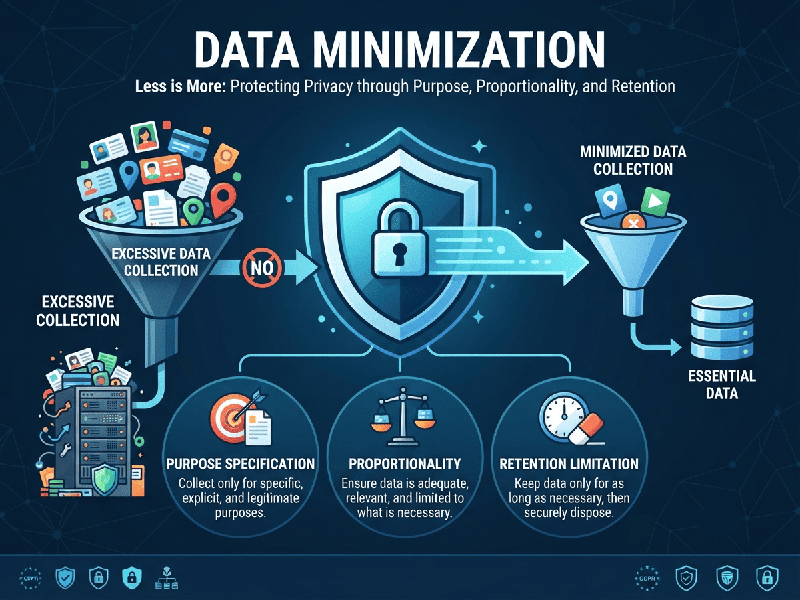
Data Minimization is a core cybersecurity and privacy principle that
dictates organizations should collect, process, and retain only the absolute
minimum amount of personally identifiable information (PII) or sensitive data
necessary to fulfill a specific, legitimate business purpose.
Rooted in regulatory frameworks like the European
Union's GDPR (General Data Protection Regulation) and global privacy standards,
this approach shifts the security philosophy from "collect everything just
in case" to "collect only what is required, and delete it when no
longer needed."
Core Principles of Data Minimization
1.
Adequacy and Relevance: Ensuring that every data field collected directly serves the
stated business objective. If an application can function without a user's date
of birth or home address, those fields should not be requested.
2.
Storage Limitation (Retention Limits): Data should not be kept indefinitely. Organizations
must establish clear lifecycle policies defining how long data is stored before
it is securely archived or permanently deleted.
3.
Purpose Limitation: Data collected for one specific reason (e.g., shipping an order) cannot
be silently repurposed for unauthorized tracking or secondary marketing without
explicit user consent.
4.
Access Limitation: Restricting internal access to collected data on a strict need-to-know
basis, ensuring only authorized personnel can view sensitive records.
Key Benefits for Cybersecurity and Business
- Reduced Attack Surface: The less data an organization
holds, the less attractive it is to cybercriminals. If a breach occurs,
the volume of exposed PII is minimized, drastically lowering financial and
reputational damage.
- Lower Compliance Risk: Compliance with privacy
regulations (GDPR, CCPA, HIPAA) becomes significantly easier when data
inventories are clean, lean, and systematically purged.
- Decreased Storage and Management
Costs: Storing
massive troves of dark data (unused or unmanaged data) incurs unnecessary
cloud storage overhead and administrative indexing costs.
- Enhanced User Trust: Consumers are increasingly
protective of their digital footprint; transparent data practices build
brand loyalty and consumer confidence.
Best Practices for Implementation
- Audit and Inventory Existing
Data: Conduct
regular data discovery scans to map out what data is currently collected,
where it is stored, who can access it, and why it was gathered.
- Adopt Privacy by Design: Integrate data minimization
requirements directly into the software development lifecycle (SDLC)
before new features, forms, or databases are built.
- Automate Retention and Deletion
Policies:
Implement automated scripts and database triggers that securely wipe or
anonymize logs, user accounts, and transaction records once their
retention window expires.
- Leverage Pseudonymization and
Anonymization:
Where full datasets are required for analytics or machine learning, strip
out direct identifiers (e.g., names, emails, IP addresses) or hash the
data to break the link to individual identities.