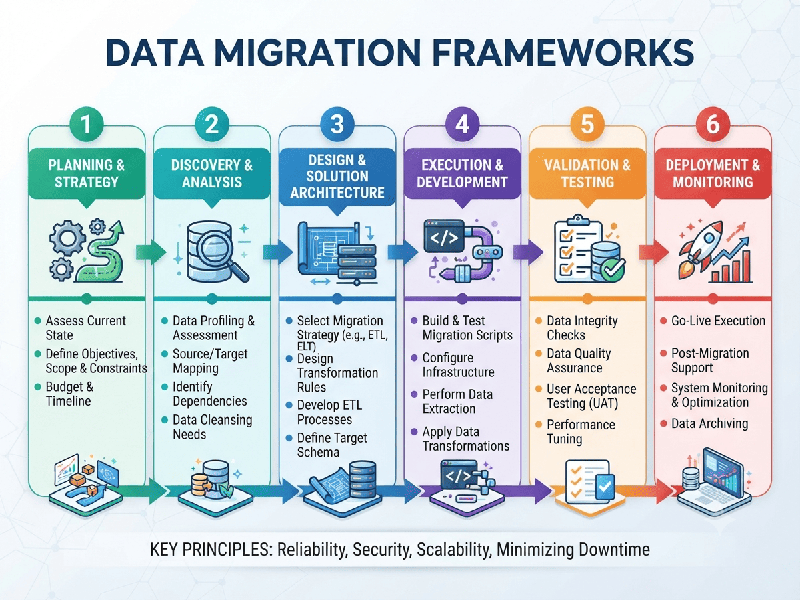
Data Migration Frameworks
Data migration frameworks are essential for moving
data between systems, whether you are upgrading your ERP infrastructure,
shifting to cloud-native storage, or consolidating databases. In 2026, the
focus has shifted toward automated, metadata-driven pipelines that
minimize downtime and ensure data integrity.
1. Open-Source & Developer-Focused Frameworks
For teams that prefer programmatic control,
infrastructure-as-code, and avoiding vendor lock-in, these frameworks are the
standard.
- Apache Airflow: The industry standard for
orchestrating complex data workflows. While not a "migration
tool" per se, it is the primary engine used to schedule and monitor
the various tasks required during a migration.
- Debezium: The go-to for Change Data
Capture (CDC). It streams changes from your legacy database to your
new target in real-time, which is critical for "zero-downtime"
migrations.
- dbt (data build tool): Excellent for transforming data
after it has been moved to a modern data warehouse (like Snowflake,
BigQuery, or Redshift). It focuses on modularity and testing.
2. Modern Approaches for 2026
Migration strategies have evolved to prioritize data
quality and business continuity:
- Zero-Downtime Migration (ZDM): Leveraging CDC (via tools like Debezium
or GoldenGate) to keep the source and target databases in sync
until the final cutover, ensuring the business stays online.
- Data Quality Frameworks (Great
Expectations):
A vital framework used during migration to validate that the data
arrived exactly as expected. It acts as an automated
"gatekeeper" that prevents corrupted data from entering the new
environment.
- AI-Assisted Schema Mapping: Tools now use AI to
automatically suggest mappings between legacy relational schemas (e.g., an
old SQL ERP) and modern NoSQL or Cloud structures, significantly reducing
the manual work for data engineers.
Selecting the Right Framework
- For Cloud Transformation: Use cloud-native services like AWS
DMS or Azure Data Factory to take advantage of integrated
security and performance tuning.
- For Custom/Legacy to Modern: Use Talend or Informatica
if the business logic is complex and requires extensive data cleansing.
- For Agility & Scale: Use Apache Airflow + dbt
to build a pipeline that can be tested, version-controlled, and reused for
future migrations.