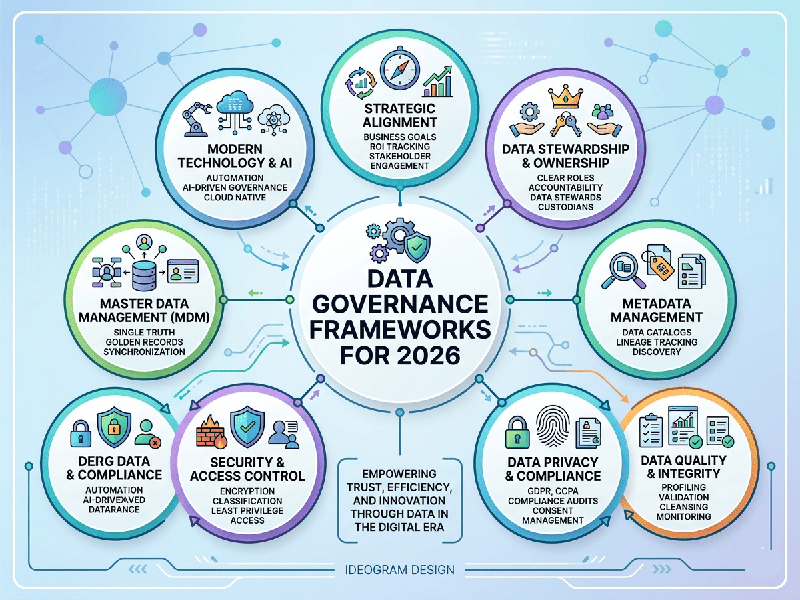
Data Governance Frameworks for 2026
Data governance has shifted from a "defensive"
compliance activity to an "offensive" strategic asset. Frameworks are
no longer just static documents; they are active intelligence layers
that govern not just data, but the AI agents and machine learning pipelines
that consume it.
1. DAMA-DMBOK 2.0 (The Comprehensive Standard)
The Data Management Body of Knowledge (DAMA-DMBOK) remains
the "gold standard" for organizations building a data-centric culture
from the ground up.
- Core Focus: It organizes data management
into 11 "Knowledge Areas" (the DAMA Wheel), placing Data
Governance at the center as the coordinating force.
- Best For: Establishing technical
disciplines like Master Data Management (MDM), Metadata Management, and
Data Quality.
- 2026 Utility: It is the primary guide for
creating Data Product Managers—a role that treats datasets as
products with defined lifecycles.
2. NIST AI RMF & ISO 42001 (The AI-First Frameworks)
With the EU AI Act high-risk enforcement beginning in August
2026, these frameworks have become non-negotiable for anyone using
generative or agentic AI.
- NIST AI Risk Management
Framework (RMF):
Organizes governance into four functions: Govern, Map, Measure, and
Manage. It is the operational "playbook" for mitigating AI
bias and drift.
- ISO/IEC 42001: This is the world’s first
certifiable AI management system standard. In 2026, being ISO 42001
certified is becoming a prerequisite for B2B procurement in the tech
sector.
- Key Feature: Focuses heavily on Data
Provenance—tracking exactly which data was used to train which model
to ensure ethical compliance.
3. COBIT 2026 (The Compliance & Audit Framework)
Developed by ISACA, COBIT (Control Objectives for
Information and Related Technology) is the preferred framework for heavily
regulated industries (Finance, Healthcare).
- Core Focus: Aligning IT goals with business
objectives and providing audit-ready controls.
- 2026 Utility: It is widely used for SOX/GDPR/India
DPDP compliance. It excels at separating "Governance" (the
Board's oversight) from "Management" (the IT department's
execution).