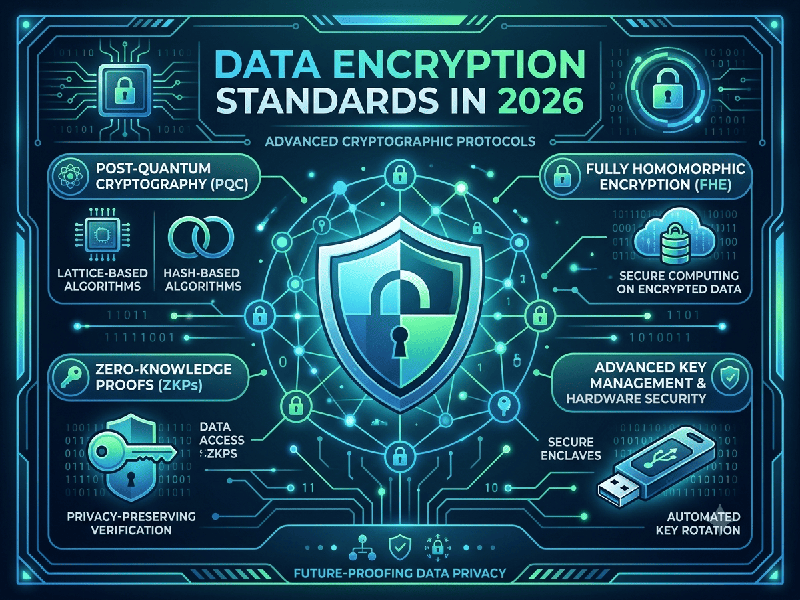
Data Encryption Standards in 2026
The landscape of data encryption is defined by a shift
from reactive, perimeter-based security to proactive, data-centric, and
quantum-resistant strategies. As cyber threats become more sophisticated
and data more fragmented across AI workflows and multi-cloud environments,
encryption is no longer just a technical checkbox—it is a core business
requirement.
1. The Core Encryption Standards (The "Gold
Standard")
For most standard operations and data protection, the
industry continues to rely on well-established, robust cryptographic
algorithms.
- Data at Rest: AES-256 (Advanced
Encryption Standard with a 256-bit key) remains the global gold standard.
It is the mandatory requirement for compliance in major sectors like
healthcare (HIPAA) and finance (PCI-DSS).
- Data in Transit: TLS 1.3 is the preferred
protocol. It improves security and performance over TLS 1.2 by
streamlining the handshake process and removing outdated, vulnerable
cryptographic primitives.
- Key Exchange/Asymmetric: While traditional RSA and ECC
(Elliptic Curve Cryptography) remain in use for immediate needs, they are
under a mandatory transition phase due to the looming threat of quantum
computing.
2. The 2026 Shift: Post-Quantum Cryptography (PQC)
The most significant development in 2026 is the urgent
transition to Post-Quantum Cryptography (PQC). Large-scale quantum
computers threaten to break current asymmetric encryption (RSA/ECC) using
algorithms like Shor’s algorithm.
- NIST Standards: Following the finalization of
standards (FIPS 203, 204, and 205), organizations are now in the middle of
a "rip-and-replace" cycle.
- Operational Reality: By 2026, PQC readiness is no
longer an "academic experiment." It has become a non-negotiable
procurement requirement for government agencies and regulated
industries.
- The "Harvest Now, Decrypt
Later" Threat: Attackers are currently capturing and storing encrypted data with
the intent to decrypt it once quantum technology matures. This makes PQC
migration an immediate priority for long-lived, sensitive data.
3. Data-Centric Security & Encryption in Use
Regulators (such as those enforcing DORA in the EU and
updated NIST CSF 2.0 frameworks) are moving away from trusting the
"perimeter." They now demand proof that data is protected everywhere
it lives.
- Encryption in Use: Traditional encryption protects
data at rest (on a disk) or in transit (over a network). Advanced
organizations are now implementing Confidential Computing and Privacy-Enhancing
Technologies (PETs) to allow data to remain encrypted while being
processed in memory by AI models or database queries.
- Field-Level Encryption: Instead of encrypting an entire
database volume, the industry is shifting to granular, field-level
encryption. This ensures that even if an application layer is breached
(e.g., via SQL injection), the specific sensitive data (like SSNs or
diagnosis codes) remains ciphertext.
- Crypto-Agility: This is the most critical
organizational capability of 2026. It is the ability to switch out
cryptographic algorithms, keys, or protocols via configuration rather than
hard-coded changes. This allows teams to respond to new threats or
regulatory changes without rebuilding their entire infrastructure.