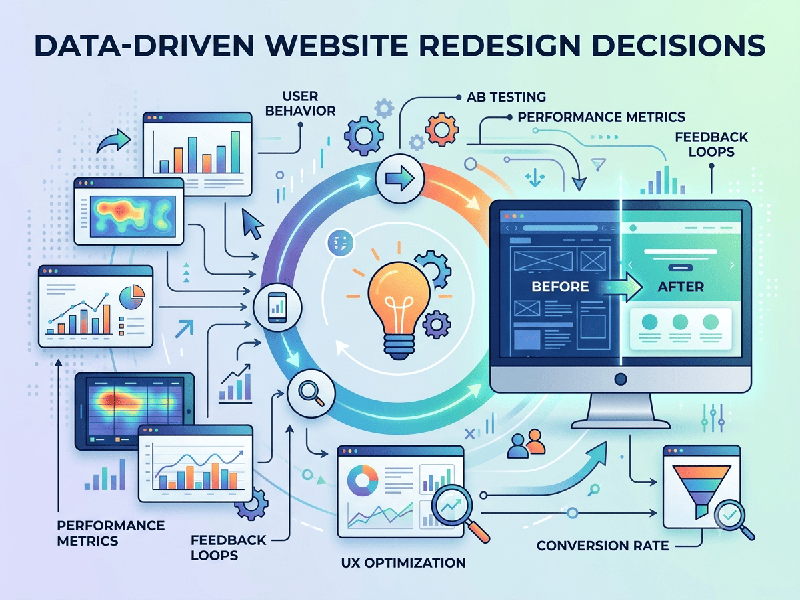
Data-Driven Website Redesign Decisions
Making data-driven
website redesign decisions relies on quantitative metrics and qualitative
user insights to guide structural, visual, and functional changes, replacing
design guesswork with measurable evidence.
Phase-by-Phase
Redesign Workflow
- Phase 1: Baseline Audit &
Goal Setting
- Map high-performing pages
versus underperforming assets.
- Establish baseline metrics for
conversion, load speed, and user engagement to evaluate post-launch
success.
- Phase 2: User Friction Mapping
- Analyze heatmaps to discover
dead clicks, skipped sections, and unclicked calls-to-action (CTAs).
- Watch session recordings of
dropped checkout or sign-up flows to isolate UX bottlenecks.
- Phase 3: Hypothesis &
Prototyping
- Formulate testable hypotheses
(e.g., "Simplifying navigation from 8 items to 4 will increase
primary CTA clicks").
- Build low-fidelity wireframes
directly targeting identified friction points.
- Phase 4: Validation &
Pre-Launch Testing
- Conduct A/B testing or split
testing on high-traffic pages before committing to global layout changes.
- Run unmoderated usability tests
on interactive prototypes to validate task completion rates.
- Phase 5: Post-Launch
Optimization
- Compare post-launch performance
against pre-redesign baselines.
- Continuously monitor
crawlability, indexing, and core web vitals to prevent SEO regressions.