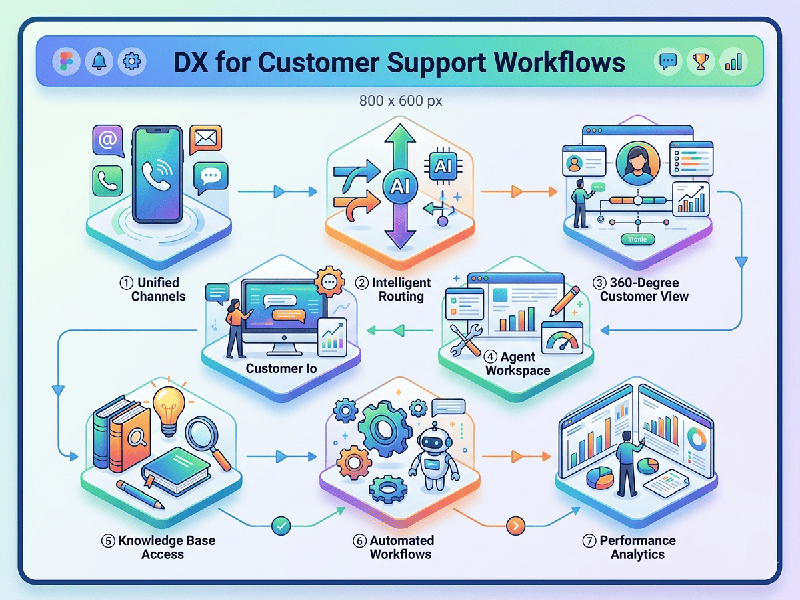
DX for Customer Support Workflows
Digital Transformation (DX) for customer support has moved beyond basic
automation to predictive resolution and unified ecosystems. The
goal is no longer just "deflecting tickets" but creating a seamless,
"channel-less" experience where the technology acts as a bridge
between the customer’s intent and a verified solution.
1. Core Components of a Modern DX Workflow
To transform support workflows, organizations focus on three
foundational pillars: Unified Data, Intelligent Automation, and Agent
Augmentation.
A. Unified Customer Profiles (The 360° View)
Instead of siloed inboxes (Email vs. WhatsApp vs. App), DX
centralizes all interactions into a single timeline.
- Context Preservation: If a customer starts a query on
WhatsApp and finishes it via a web portal, the history follows them.
- Integrated CRM: Support tools now pull
real-time data from sales, marketing, and logistics to provide instant
context (e.g., seeing a delivery delay while the customer is still
typing).
B. Intelligent Automation & AI Agents
In 2026, AI is treated as "infrastructure" rather
than a novelty.
- Agentic AI: Tools like Intercom Fin
or Ada don't just provide links; they perform actions like
processing refunds, updating addresses, or validating documents
autonomously.
- Predictive Support: Systems analyze usage patterns
to reach out before a failure occurs (e.g., "We noticed your
API latency is high; here is a fix").
C. Agent Copilots (EX = CX)
Employee Experience (EX) is now recognized as a driver of
Customer Experience (CX).
- Real-time Assistance: AI suggests responses,
retrieves knowledge base articles, and summarizes long conversation
threads for agents.
- Sentiment Analysis: Flags frustrated customers
early so they can be prioritized for senior human intervention.