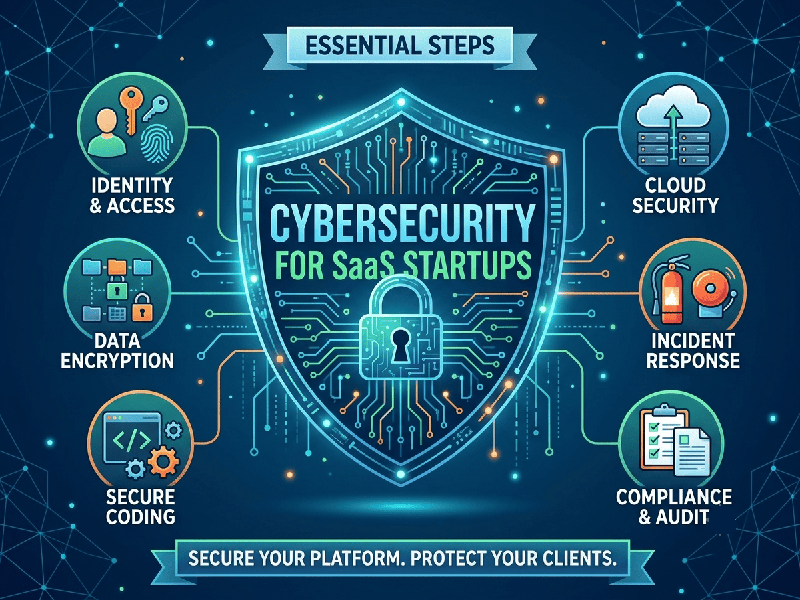
Cybersecurity for SaaS Startups
Cybersecurity for SaaS Startups is the operational framework
required to protect customer data, secure application pipelines, and prevent
system breaches. For early-stage SaaS companies, security is not just an IT
requirement—it is a critical sales driver, as B2B enterprise buyers demand
proof of robust data protection before closing contracts.
Core Pillars of SaaS Startup Security
- Data Isolation & Application
Security:
Implement strict multi-tenant data boundaries to
prevent data bleeding between accounts. Enforce encryption for data at rest
(AES-256) and in transit (TLS 1.3), along with parameterized database queries
to block SQL injection vulnerabilities.
- Identity & Access Management
(IAM):
Centralize identity through Single Sign-On (SSO) and
mandatory Multi-Factor Authentication (MFA) across all internal environments
and external application interfaces. Apply the Principle of Least Privilege
(PoLP) to restrict developer production access.
- DevSecOps & Software Supply
Chain Security:
Shift security left into CI/CD pipelines by embedding
Static Application Security Testing (SAST), Dynamic Application Security
Testing (DAST), and dependency vulnerability scanners to prevent vulnerable
third-party libraries from reaching production.
- Infrastructure & Cloud
Security Posture Management (CSPM):
Deploy SaaS and Cloud Security Posture Management
tools to monitor misconfigurations, open storage buckets, and unpatched
production servers across AWS, GCP, or Azure.
- Vendor & Third-Party Risk
Management:
Audit third-party APIs, SaaS integrations, and
subprocessors to prevent upstream breaches from compromising customer
databases.