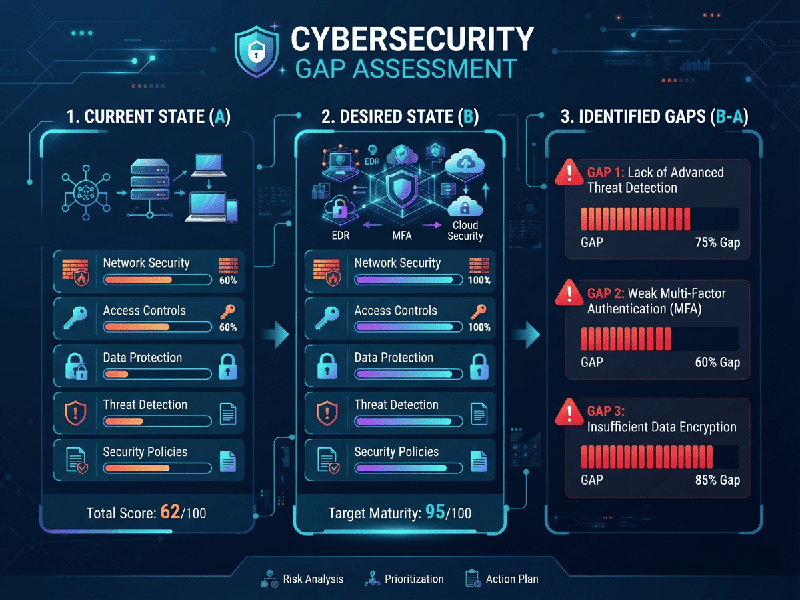
Cybersecurity Gap Assessment
Cybersecurity Gap Assessment is a strategic evaluation process
that compares an organization's current security posture, technical controls,
and operational policies against established industry frameworks (such as ISO
27001, NIST CSF, SOC 2, or HIPAA) to identify vulnerabilities, missing
safeguards, and compliance deficiencies.
Core Objectives of a Gap Assessment
- Determine Baseline Security: Discover where the organization
actually stands today regarding data protection, access controls, and
threat detection.
- Identify Vulnerabilities &
Blind Spots:
Uncover technical, physical, and procedural flaws before malicious actors
or auditors exploit them.
- Prioritize Remediation: Establish a clear,
risk-adjusted roadmap so security teams can fix high-impact issues first
with limited resources.
- Ensure Regulatory Compliance: Verify whether current controls
align with legal mandates, data privacy laws (like GDPR, DPDP), and client
vendor-risk requirements.
Step-by-Step Methodology
1. Define Scope and Select Framework
- Framework Selection: Choose the standard that fits
your industry and business goals (e.g., NIST Cybersecurity Framework
(CSF) for general risk management, ISO 27001 for international
security management systems, or PCI-DSS for payment processing).
- Boundary Definition: Decide whether the assessment
covers the entire enterprise, specific cloud environments, remote work
infrastructure, or critical product lines.
2. Data Gathering & Discovery
- Documentation Review: Audit existing security
policies, incident response plans, employee training records, and network
architecture diagrams.
- Stakeholder Interviews: Consult IT, engineering, legal,
HR, and executive leadership to understand how security policies are
actually executed day-to-day versus how they look on paper.
3. Gap Analysis (Current State vs. Target State)
- Systematically evaluate control
categories across the chosen framework:
o Access Control & Identity
Management (IAM)
o Data Encryption & Privacy
o Endpoint & Network Security
o Incident Response & Business
Continuity
o Third-Party / Supply Chain Risk
- Categorize findings into status
levels (e.g., Fully Implemented, Partially Implemented, Not Implemented).
4. Risk Scoring & Prioritization
- Evaluate each identified gap
based on likelihood and potential business impact (financial,
reputational, operational).
- Avoid trying to fix everything
at once; focus heavily on high-risk vulnerabilities that expose core
assets.
5. Action Plan & Roadmap Generation
- Deliver a formal executive
report detailing the gaps, root causes, estimated remediation costs, and
proposed timelines.
- Assign clear accountability
owners for each corrective action item.