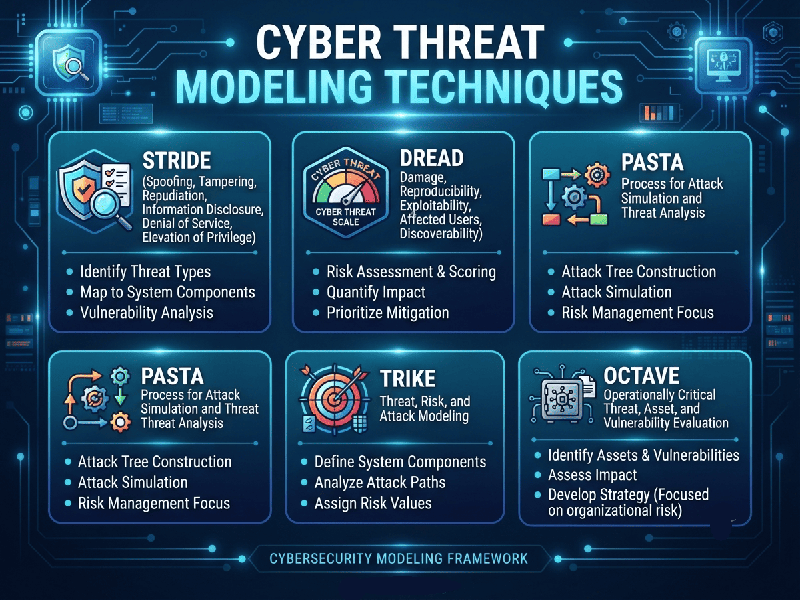
Cyber Threat Modeling Techniques
Cyber threat modeling is a structured, proactive approach
to identifying, quantifying, and mitigating security risks by viewing an
application, system, or network from an attacker's perspective.
Rather than reacting to vulnerabilities after
deployment, threat modeling helps engineering and security teams build
secure-by-design architectures.
1. Core Threat Modeling Methodologies
Different frameworks suit different organizational
needs, ranging from developer-focused code reviews to enterprise-wide risk
management.
- STRIDE (Microsoft): The most widely used threat
classification model. It categorizes threats into six types based on the
security properties they violate:
o Spoofing (Identity)
o Tampering (Integrity)
o Repudiation (Non-repudiation)
o Information Disclosure (Confidentiality)
o Denial of Service (Availability)
o Elevation of Privilege (Authorization)
- PASTA (Process for Attack
Simulation and Threat Analysis): A risk-centric, 7-stage framework that aligns technical
security requirements with business objectives. It evaluates real-world
adversary tactics and attack simulations.
- VAST (Visual, Agile, and Simple
Threat modeling): Designed to integrate seamlessly into Agile and DevOps pipelines,
allowing scalable threat modeling across large software portfolios.
- LINDDUN: A privacy-focused counterpart
to STRIDE used to identify and mitigate privacy threats (Linkability,
Identifiability, Non-repudiation, Detectability, Disclosure of
information, Unawareness, Non-compliance).
- OCTAVE (Operationally Critical
Threat, Asset, and Vulnerability Evaluation): A risk-based strategic
assessment framework focused primarily on organizational and operational
risks rather than purely technical code flaws.
2. The Standard Threat Modeling Process
Regardless of the framework chosen, the execution
typically follows a sequential 5-to-6-step lifecycle:
1.
Define Scope and Objectives: Identify what is being modeled (an API, a microservice, a
cloud database) and establish goals, compliance needs, and security baselines.
2.
Deconstruct the System (Create Data Flow Diagrams): Map out the system architecture.
Visualize data flows, external dependencies, trust boundaries, and entry/exit
points.
3.
Identify Threats: Systematically ask, "What can go wrong?" using
frameworks like STRIDE mapped against your data flow components.
4.
Evaluate and Prioritize Risks: Score threats based on likelihood and impact using
quantification metrics (such as CVSS or DREAD—Damage, Reproducibility,
Exploitability, Affected users, Discoverability) to determine which issues
require immediate remediation.
5.
Design and Implement Mitigations: Build countermeasures into the architecture (e.g.,
implementing strict mTLS for service-to-service communication, token-based
authentication, or input sanitization).
6.
Validate and Iterate: Re-evaluate the model when the system architecture changes or new attack
vectors emerge.
3. Modern
Evolutions & Emerging Trends
- AI-Specific Threat Modeling: With the proliferation of
generative and autonomous tools, specialized frameworks like MAESTRO
(Multi-Agent Environment, Security, Threat, Risk, and Outcome) are used to
model vulnerabilities unique to agentic AI systems and LLM supply chains.
- Shift-Left Automation: Integrating open-source threat
modeling tools (like OWASP Threat Dragon or IriusRisk)
directly into CI/CD pipelines to flag architectural risks during the
pull-request phase.