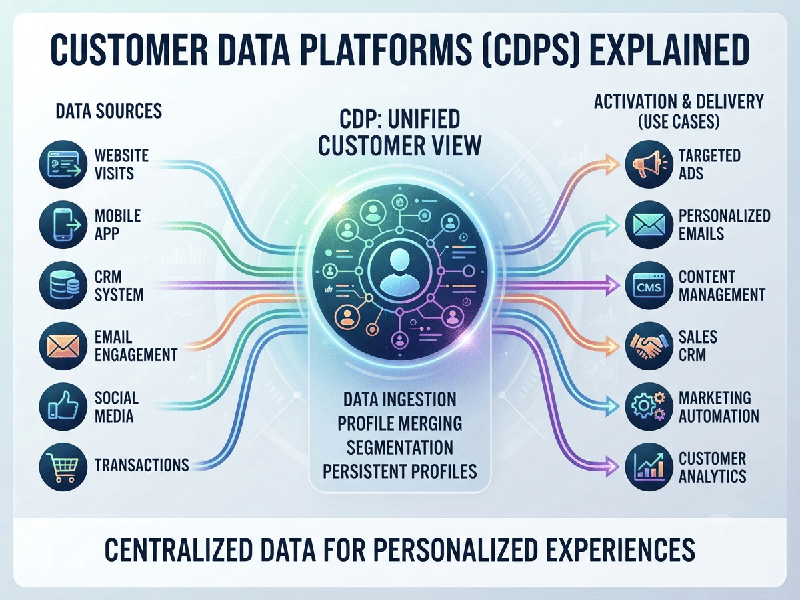
Customer Data Platforms (CDPs) Explained
Customer Data Platforms (CDPs) are specialized software systems
that collect, aggregate, and unify customer data from multiple touchpoints and
sources into a single, centralized, and persistent database. This creates a
single customer view (often called a 306-degree profile or unified
profile) accessible to other marketing, sales, and analytics systems.
1. How a CDP Works (The 4 Core Phases)
A CDP processes data through an automated lifecycle
designed to turn raw information into actionable insights:
- Ingest (Data Collection): Pulls first-party data from
online and offline sources. This includes website tracking, mobile apps,
CRM systems, customer service logs, transactional databases, and
point-of-sale (POS) terminals.
- Unify (Identity Resolution): Connects disparate pieces of
data belonging to the same individual. For example, it links an anonymous
website visitor's browsing session to their logged-in user profile, email
address, and past purchases once they authenticate.
- Profile (Data Structuring): Cleans, organizes, and enriches
data to build comprehensive customer profiles containing historical
behaviors, preferences, and real-time attributes.
- Activate (Data Distribution): Pushes these unified profiles
and segments out to execution channels—such as email marketing tools,
advertising platforms, push notification systems, and analytics
dashboards.
2. Types of CDPs
The CDP Institute categorizes CDPs into four distinct
functional types depending on business needs:
- Data CDPs (Builder CDPs): Focus primarily on data
collection, cleaning, and identity resolution. They act as a data pipeline
to feed other tools.
- Campaign CDPs: Include data collection and
unification, but focus heavily on segmentation, multi-channel campaign
execution, and customer journey orchestration.
- Analysis CDPs: Emphasize predictive modeling,
machine learning, customer lifetime value (LTV) forecasting, and advanced
business intelligence.
- Engagement CDPs: Built to deliver real-time
personalization, messaging, and recommendations across web, mobile, and
chat channels.
3. Key Benefits of Implementing a CDP
- Eliminates Data Silos: Brings marketing, sales,
support, and e-commerce data into one unified ecosystem.
- Enables Real-Time
Personalization:
Allows brands to deliver tailored website experiences, product
recommendations, and targeted offers based on live user actions.
- Improves Data Privacy
Compliance:
Centralized data storage makes it easier to comply with privacy
regulations like GDPR and CCPA by streamlining consent management and data
deletion requests.
- Reduces Advertising Waste: By feeding clean, first-party
segments into ad networks, companies avoid retargeting users who have
already converted.