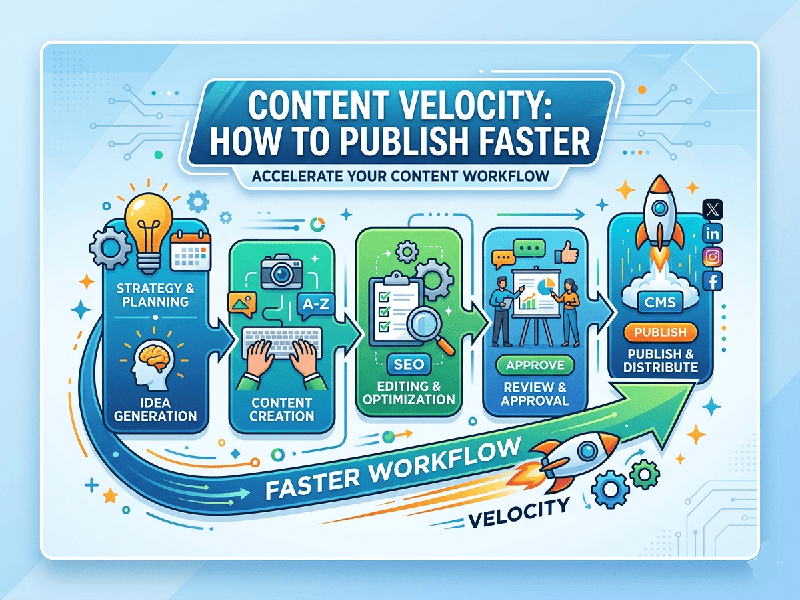
Content Velocity: How to Publish Faster
Increasing your content velocity—the rate at which
your team ideates, produces, and publishes content—requires moving from a
"handcrafted" approach to a systematized production engine.
To scale without sacrificing quality, focus on these five
core pillars:
1. Standardize and Document Workflows
Content often stalls because of ambiguity. If every piece of
content follows a different process, you are reinventing the wheel every time.
- Map the Lifecycle: Clearly define the journey from
Idea $\rightarrow$ Outline $\rightarrow$ Draft
$\rightarrow$ Review $\rightarrow$ Publish.
- Establish Governance: Assign a Directly
Responsible Individual (DRI) for every stage. When everyone knows who
is responsible for the next step, you eliminate "bottleneck
paralysis."
- Use Checklists: Create specific
quality-assurance checklists for researchers, writers, and editors to
ensure consistency and prevent errors that lead to redo loops.
2. Adopt a "Content Pillar" Strategy
Avoid the "blank page" syndrome by anchoring your
production in core themes.
- Create Cornerstone Content: Develop comprehensive,
long-form assets (guides, whitepapers, or pillar pages) that cover a topic
in depth.
- Repurpose Systematically: Break that one pillar asset
into dozens of micro-assets: social media threads, newsletter segments,
short-form video scripts, and infographics.
- The Multiplier Effect: By repurposing, you get 10x the
output for the same amount of research and strategic planning time.
3. Leverage "Content as Data"
Treat your content like a database rather than a collection
of documents.
- Modular Content: Use a CMS that supports modular
blocks. If you update a product specification or a key statistic in your
"source of truth" system, it should automatically update across
all associated pages.
- Templates: Create standardized templates
for your briefs, outlines, and final drafts. This keeps the formatting
consistent and saves time on design and structural decisions.
4. Integrate AI and Automation
AI is a force multiplier, not a replacement for strategy.
- Ideation & Outlining: Use Generative AI (e.g.,
ChatGPT, Claude, Jasper) to generate brainstorming lists, competitor gap
analyses, and detailed content outlines.
- Workflow Automation: Use platforms like Zapier or
built-in CMS workflows to automatically notify the next stakeholder when a
task is completed, preventing "dead time" between production
stages.
- SEO Automation: Use tools like SurferSEO or
Clearscope to handle the technical SEO optimization layer, allowing
writers to focus on narrative and value.
5. Centralize Your "Single Source of Truth"
Fragmented tools are the enemy of speed.
- Consolidate Your Stack: Avoid switching between email,
spreadsheets, and document editors. Use project management software (e.g.,
Asana, Jira, Notion) to house the entire process from brief to publish.
- Shared Asset Hub: Centralize your images, videos,
and brand kits. If a freelancer or team member doesn't have to "ask
for the logo" or "track down the latest brand guidelines,"
they can work autonomously.