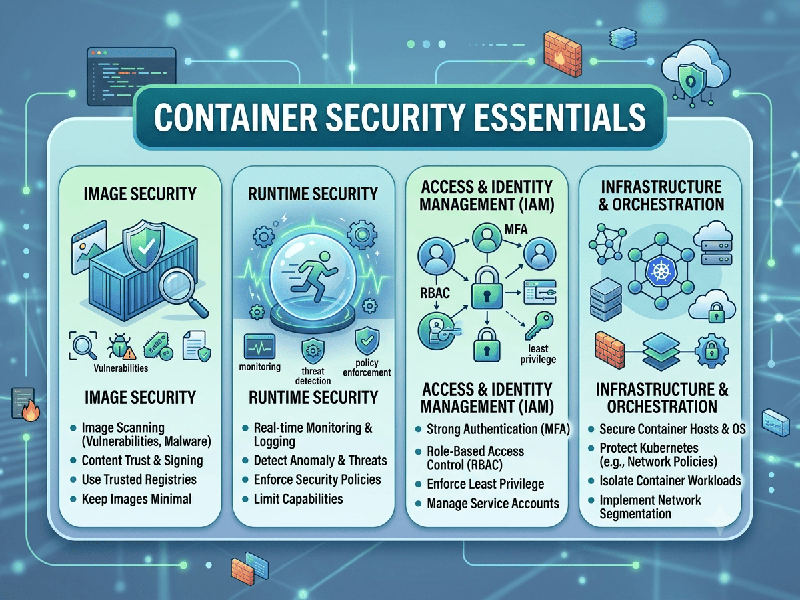
Container Security Essentials
Container security is a layered discipline that
protects the entire lifecycle of a containerized application—from the initial
code and build phase to the runtime environment and orchestration layer.
Because containers share the host kernel, a security breach in one can
potentially compromise the host or other containers if not properly isolated.
Core Security Essentials
1. Shift-Left Security (Build Phase)
Integrate security into the development process
rather than treating it as an afterthought.
- Vulnerability Scanning: Automatically scan container
images for known vulnerabilities in your CI/CD pipeline.
- Minimalist Images: Use "distroless" or
minimal base images (like Alpine) to reduce the attack surface by removing
unnecessary packages, shells, and utilities.
- Software Bill of Materials
(SBOM):
Maintain an SBOM to track all dependencies, making it easier to identify
and patch vulnerable libraries.
2. Image and Registry Integrity
- Trusted Sources: Only use images from verified,
reputable registries. Avoid pulling random images from public hubs without
vetting.
- Image Signing: Digitally sign your images. Use
tools (like Cosign/Sigstore) to verify that an image has not been tampered
with between the build and deployment stages.
3. Runtime Protection and Isolation
- Principle of Least Privilege: Never run containers as root.
Define a specific, non-privileged user in your Dockerfile.
- Runtime Security Monitoring: Use tools to detect anomalous
behavior (e.g., a container suddenly trying to spawn a shell or access
sensitive files) and kill the process or alert the team immediately.
- Immutable Infrastructure: Do not patch running
containers. If an update is needed, build a new image and redeploy. This
prevents "configuration drift."
4. Network and Orchestration Security
- Network Segmentation: Use Kubernetes Network Policies
to restrict "east-west" traffic. A frontend service should have
no technical reason to talk to a database directly; limit communication to
only what is required.
- Secrets Management: Never hardcode passwords, API
keys, or tokens in your container images or environment variables. Use
dedicated secrets managers (like HashiCorp Vault, AWS Secrets Manager, or
Kubernetes Secrets).
- Orchestration Hardening: Implement strict Role-Based
Access Control (RBAC) to limit who can modify cluster configurations and
use Admission Controllers to enforce security policies (e.g., blocking
privileged containers).