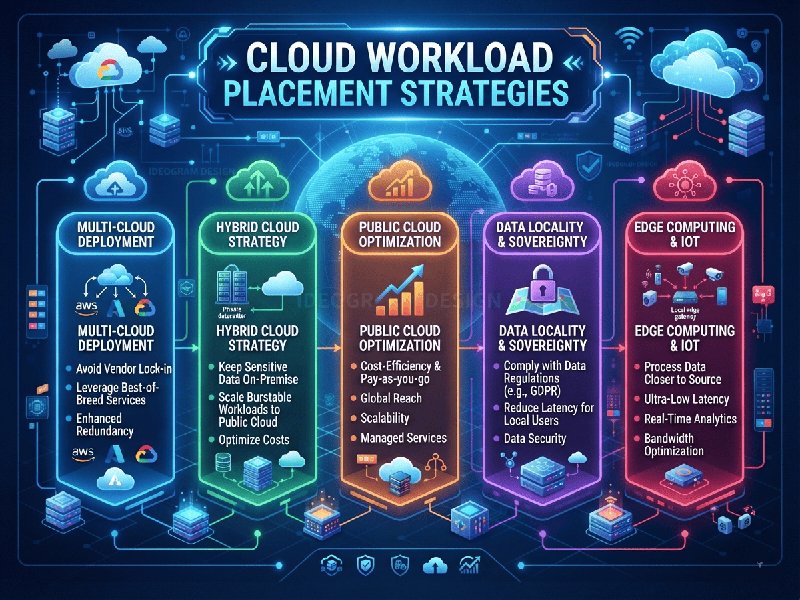
Cloud Workload Placement Strategies
Cloud Workload Placement Strategies involve systematically deciding
where specific applications, data models, and microservices should run (e.g.,
on-premises, private cloud, or across specific public cloud providers like AWS,
Azure, or GCP) to optimize for performance, compliance, and total cost.
An effective workload placement strategy evaluates
four primary variables:
1. Core Decision Variables
- Performance Sensitivity
(Latency):
Determine how critical response time is. User-facing applications (like
checkout workflows or real-time streaming) require placement
geographically close to end-users or on low-latency edge networks, whereas
background batch jobs (like nightly ETL pipelines) can run anywhere.
- Data Gravity: Compute naturally follows data.
Moving massive multi-terabyte or petabyte-scale databases across cloud
regions or providers incurs steep costs and network bottlenecks. Keep
compute tightly co-located with primary data sets.
- Regulatory & Compliance
Zones: Sovereign
requirements (such as GDPR in Europe or local financial data residency
mandates) dictate that certain data and workloads cannot leave specific
geographic borders or unauthorized cloud environments.
- Cost Elasticity & Unit
Economics:
Evaluate compute pricing dynamically. Take advantage of spot instances or
preemptible nodes for batch/fault-tolerant workloads, while mapping
steady-state workloads to reserved capacity or private infrastructure
where unit costs are lowest.
2. Common Structural Strategies
Hybrid and Multi-Cloud Placement
- Best-of-Breed Strategy: Distributing workloads to the
cloud provider that offers the absolute best managed service for that
specific task (e.g., running machine learning pipelines on GCP, relational
databases on AWS, and enterprise applications on Azure).
- Primary + Cloud Bursting: Running a baseline application
stack on private infrastructure or a primary cloud, and dynamically
"bursting" overflow traffic into a secondary public cloud during
high-demand spikes without provisioning permanent idle capacity.
Migration & Modernization Frameworks (The 6 Rs)
When evaluating existing workloads for cloud
placement, architectures are typically categorized into:
- Rehost (Lift-and-Shift): Moving applications directly to
the cloud without code changes. Best for quick migrations with minimal
upfront engineering.
- Refactor/Re-architect: Rebuilding applications
natively into microservices and containers (e.g., Kubernetes) to fully
exploit cloud-native scalability and portability.
- Repurchase (Drop-and-Shop): Switching from a traditional
on-prem license to a SaaS-based alternative (e.g., moving local CRM to a
cloud-native platform).
3. Key Implementation Best Practices
1.
Calculate "Total Placed Cost": Never base placement solely on base
compute pricing. Factor in storage I/O, licensing fees, and data egress
charges (moving data between clouds can quietly erode 10–20% of expected
savings).
2.
Tag and Classify Metadata: Use container annotations, infrastructure-as-code (IaC)
tags, or orchestration labels (e.g., latency-sensitive=true, sovereignty=eu) so
automated schedulers and node placement tools (like Karpenter or custom
Kubernetes policies) can route workloads accurately.
3.
Ensure Portability via Containerization: Abstract workloads using Docker and
Kubernetes to prevent vendor lock-in, enabling your engineering teams to shift
workloads seamlessly if pricing or performance profiles change.