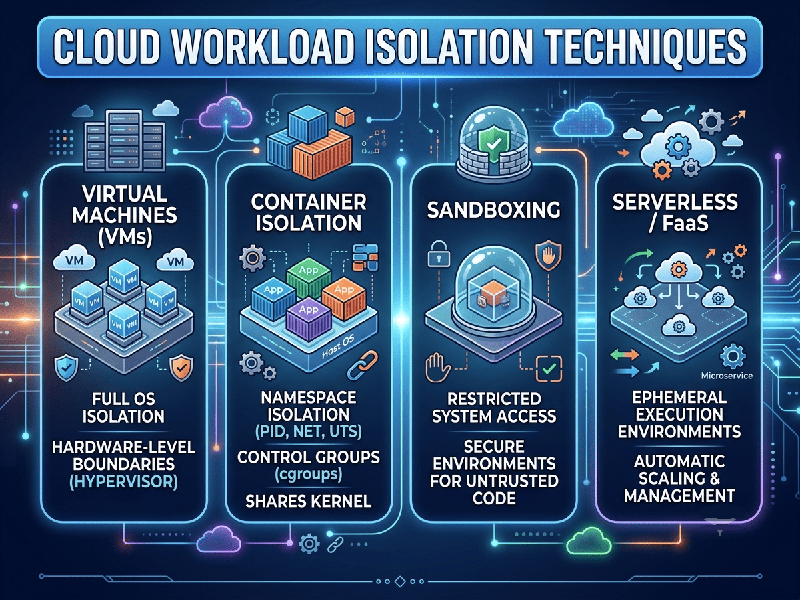
Cloud Workload Isolation Techniques
Hardware and Hypervisor-Level Isolation
- Dedicated Hosts & Instances: Provisions physical hardware
exclusively for a single tenant, eliminating noisy-neighbor performance
interference and side-channel cross-contamination risks.
- Hardware-Assisted
Virtualization:
Leverages Type-1 hypervisors (e.g., KVM, VMware ESXi) to establish rigid
security boundaries enforced directly by CPU extensions.
Container and MicroVM Sandboxing
- Lightweight MicroVMs: Utilizes technologies like AWS
Firecracker or Kata Containers to combine the speed of containers with the
strong hardware isolation of traditional virtual machines.
- Kernel Namespaces and cgroups: Employs Linux control groups
and namespaces to logically partition process trees, file systems, and
resource consumption.
Network Microsegmentation & Software-Defined
Perimeters
- Virtual Private Clouds (VPCs)
& Subnets: Segregates
workloads into distinct IP address spaces with strict ingress/egress
filtering via stateful firewalls and security groups.
- Mutual TLS (mTLS) & Service
Meshes:
Enforces cryptographic identity verification and policy-driven traffic
encryption between microservices using tools like Istio or Linkerd.
Confidential Computing and Cryptographic Protection
- Memory Encryption Extensions: Utilizes hardware-based trusted
execution environments (TEEs) like AMD SEV, Intel SGX, or AWS Nitro
Enclaves to encrypt data in use, preventing the host hypervisor or cloud
operator from inspecting memory.