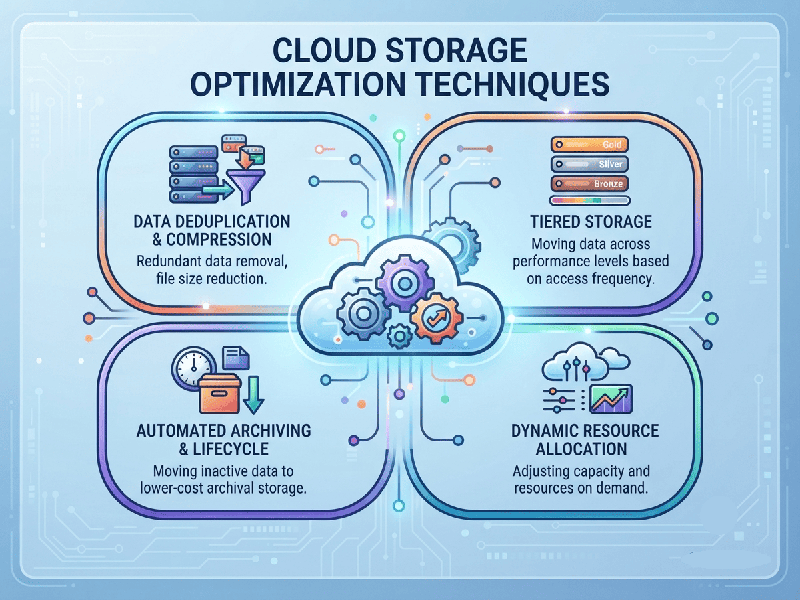
Cloud Storage Optimization Techniques
Effective Cloud Storage Optimization balances
high performance, seamless data availability, and minimized cloud expenditure.
1. Storage Tiering and Lifecycle Management
Not all data requires the same level of performance or
availability. Leveraging automated cloud policies ensures data is stored in the
most cost-effective tier:
- Hot Storage: High-performance tiers (e.g.,
AWS S3 Standard, Google Cloud Standard) for actively used,
performance-critical data.
- Warm/Cool Storage: Lower-cost tiers (e.g., AWS S3
Infrequent Access, Google Nearline/Coldline) for data accessed less
frequently but requiring rapid retrieval when needed.
- Cold/Archive Storage: Deep-archive tiers (e.g., AWS
S3 Glacier, Google Archive) for long-term compliance backups that are
rarely accessed.
- Lifecycle Policies: Automate rules to transition
data across tiers or delete expired logs automatically once retention
mandates are fulfilled.
2. Data Reduction Techniques
Minimizing the physical footprint of stored data
directly slashes capacity costs:
- Compression: Encoding data using fewer bits
to decrease file sizes without compromising structural integrity or fast
retrieval.
- Deduplication: Identifying identical blocks or
files across datasets and storing only a single instance to prevent
redundant space consumption.
3. Eliminating Unused and "Zombie" Resources
Unmonitored storage accumulates waste over time:
- Orphaned Volumes: Identify and delete unattached
block storage volumes (e.g., unlinked EBS or Azure disks) left behind
after instance termination.
- Stale Snapshots and Backups: Purge outdated system backups,
obsolete virtual machine snapshots, and temporary staging buckets that are
no longer referenced by active operations.
4. Right-Sizing and Provisioning Strategies
- Dynamic/Thin Provisioning: Allocate storage capacity
incrementally based on real-time consumption rather than reserving massive
fixed blocks upfront.
- Performance Provisioning: Carefully configure IOPS
(Input/Output Operations Per Second) and throughput settings on cloud
volumes to match actual workload requirements rather than
over-provisioning peak capacity permanently.
5. Caching and Content Delivery Networks (CDNs)
- Implement caching layers or CDNs
(such as CloudFront or Cloudflare) to serve frequently requested static
assets closer to end-users. This reduces repetitive read operations
against primary cloud storage repositories, cutting down egress fees and
retrieval latency.
6. Continuous Monitoring and Governance
- Tagging Frameworks: Apply strict metadata tags
(e.g., owner, project, environment) to storage buckets and volumes to
track expenditure accurately and attribute costs back to specific business
units.
- Cost Management Tools: Utilize native cloud monitors
(such as AWS Cost Explorer, Azure Cost Management, or Google Cloud Billing
reports) alongside FinOps automated alerts to detect unexpected storage
spikes immediately.