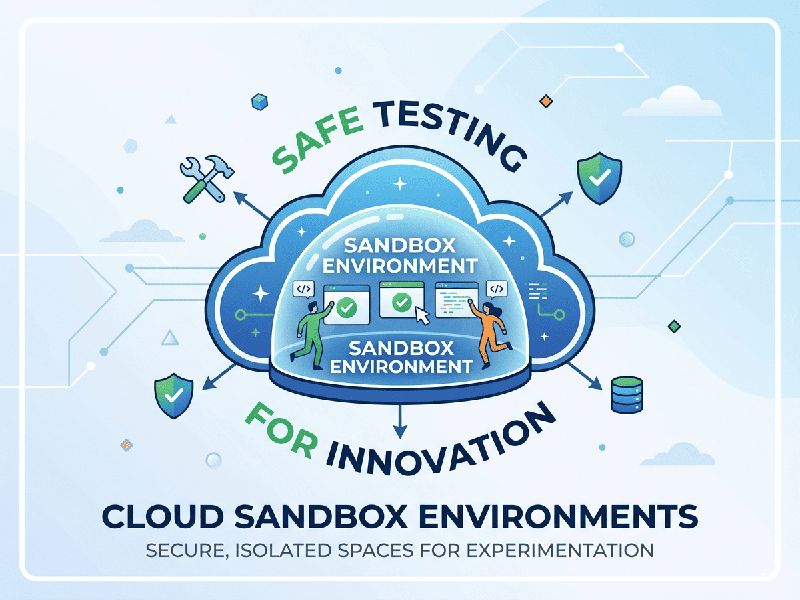
Cloud Sandbox Environments for Safe Testing
When you are building software, testing configurations, or analysing
suspicious data, the absolute last thing you want is for a mistake to bleed
into your live infrastructure. That is exactly where a cloud sandbox
environment comes in.
Think of it as a secure, isolated digital playground. It
completely mimics your live production setup, but it is entirely detached from
your core network and actual data. Anything that happens inside the sandbox
stays inside the sandbox.
Core Pillars of a Cloud Sandbox
A reliable cloud sandbox relies on two main architectural
elements to keep your testing completely safe:
- Virtualization &
Containerization: The sandbox spins up isolated Virtual Machines (VMs) or lightweight
containers (like Docker or Kubernetes). These instances behave exactly
like physical, live servers but share no direct pathways with your primary
enterprise infrastructure.
- Total Environment Emulation: Top-tier cloud sandboxes do not just run code in a vacuum; they replicate your exact operating systems, database structures, network configurations, and API integrations. This ensures that if a bug or performance bottleneck shows up during testing, it is an accurate reflection of how it would behave in production.
1. Risk-Free Code & Deployment Validation
Running untested applications on a live system risks
performance degradation, memory leaks, and catastrophic system failures. A
sandbox allows your development team to run pilot tests, deploy new features,
and catch bugs long before the code ever reaches a real user.
2. Defending Against Security Threats & Zero-Days
Sandboxes are a cornerstone of modern cybersecurity. If an
employee receives a highly suspicious file or your system flags an unknown
script, security teams can intentionally execute it inside the sandbox. By
observing its runtime behavior—like whether it tries to modify core directories
or call out to malicious IP addresses—you can neutralize zero-day exploits
without exposing your internal network to a data breach.
3. Safe Third-Party & API Integrations
Modern business applications rely heavily on external
plugins, libraries, and open-source packages. Testing these untrusted resources
inside a containerized sandbox ensures that even if a third-party tool has
hidden vulnerabilities or conflicting dependencies, your main ecosystem remains
completely pristine.