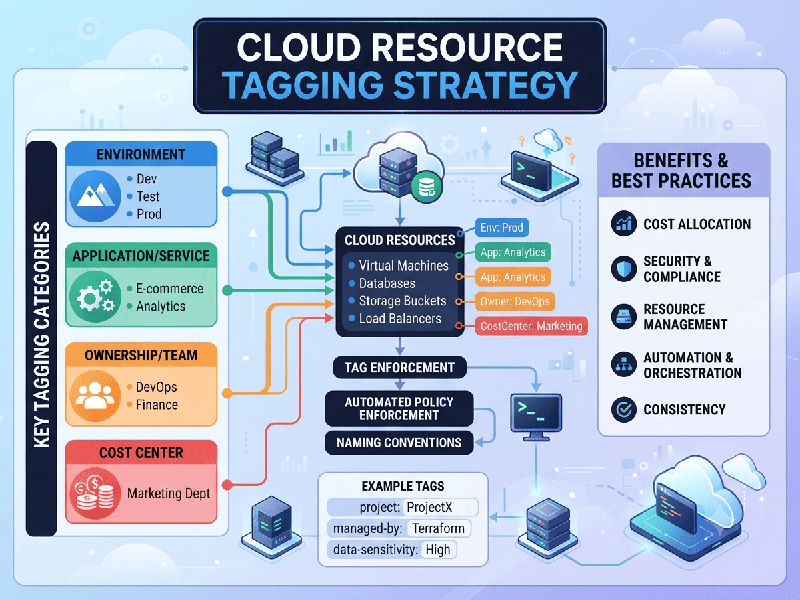
Cloud Resource Tagging Strategy
An effective cloud resource tagging strategy is the
backbone of mature cloud governance. It transforms raw infrastructure usage
into actionable business intelligence, enabling accurate cost allocation,
enhanced security, and streamlined operational automation.
Core Tagging Strategy Framework
To ensure your tagging strategy is scalable, treat it
as a centralized metadata system rather than an ad-hoc exercise.
1. The "Golden" Rules of Tagging
- Standardization: Use lowercase keys and values
exclusively. Use hyphens (-) for separators (e.g., cost-center, not
CostCenter or cost_center).
- Normalization: Define an "Allowed
Values" list (e.g., environment must only be dev, staging, or prod).
Avoid free text.
- No Sensitive Data: Never include PII (Personally
Identifiable Information), credentials, or internal secrets in tags.
- Automation-First: Do not rely on manual tagging.
Embed tags into your Infrastructure as Code (IaC) modules (Terraform,
CloudFormation, Bicep) so resources are tagged at birth.
Implementation & Governance Strategy
- Enforcement at Provisioning: Use cloud-native guardrails
(AWS Service Control Policies, Azure Policy, or GCP Org Policies) to deny
the creation of any resource that lacks the mandatory tags.
- The Tag Dictionary: Maintain a single source of
truth—a living document that defines every key, its purpose, and the
allowed values. Share this widely across teams.
- Audit Cadence: Automate monthly reports to
identify "tag sprawl" (unused or duplicate tags) and flag
untagged resources for remediation. Use tools like AWS Config, Azure
Resource Graph, or GCP Asset Inventory to automate these checks.
- FinOps Integration: Ensure your billing exports are
configured to use these tags so you can generate granular reports,
allowing for accurate ₹ (Rupee)-based cost allocation and
showback/chargeback models.
Content Strategy for Your Documentation
If you are developing educational resources or
documentation for your team, here is a suggested structure to communicate this
strategy effectively:
- Introduction: "Why Tagging
Matters"—Connect it to business outcomes like profitability analysis
and operational efficiency.
- The Policy Guide: A clear table listing the
mandatory keys, their descriptions, and the strict rules for their values.
- The Developer Workflow: A "How-to" guide
showing how to add tags in Terraform/IaC templates, emphasizing that this
is a prerequisite for deployment.
- Operational Rituals: Define a "Cleanup
Day" or monthly audit procedure where the team reviews "tag
drift" and manages unallocated spend.
- Visibility Dashboard: Showcase a template of a
financial report that uses these tags to break down costs by project or
business unit, reinforcing the value of the effort to stakeholders.