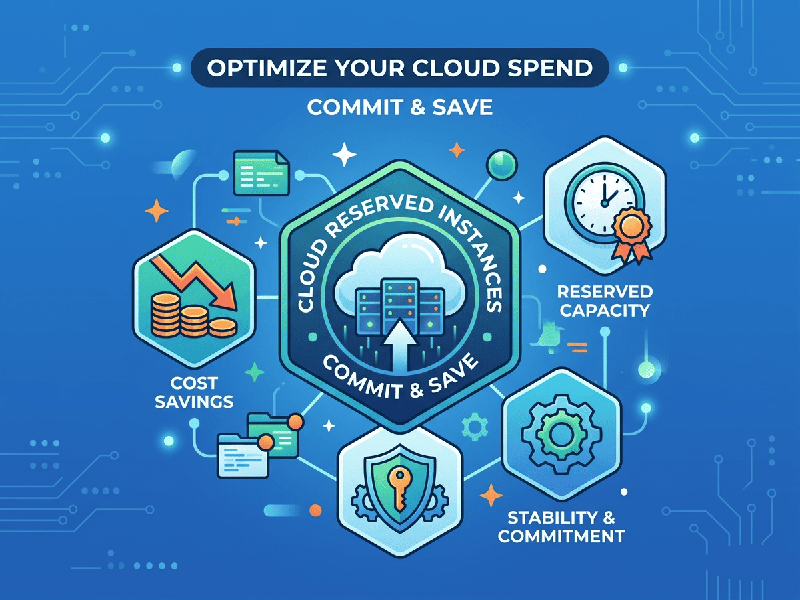
Cloud Reserved Instances
Reserved Instances (RIs) are a cloud pricing model that offers a significant
discount (up to 72–75%) compared to standard Pay-As-You-Go (On-Demand)
rates. In exchange for this discount, you commit to using a specific amount of
compute capacity for a fixed term—typically 1 year or 3 years.
1. How Reserved Instances Work
When you purchase an RI, you aren't "renting" a
specific physical server; you are purchasing a billing discount that is
automatically applied to any running instances that match your reservation's
criteria.
- Commitment Term: 1 year (moderate discount) or 3
years (maximum discount).
- Payment Options: * All Upfront: Pay the
entire term cost at once for the highest discount.
o Partial Upfront: Pay a portion now, with lower hourly
rates later.
o No Upfront: Pay a fixed monthly rate for the
duration of the term.
2. The "2026 Strategy": RIs vs. Savings Plans
Most modern cloud architectures now use a blended approach.
Relying solely on RIs can lead to "stranded costs" if your tech stack
changes (e.g., migrating from Intel to ARM/Graviton chips).
1.
The Baseline (RIs): Use these for your "always-on" infrastructure that never
changes—like core databases or legacy ERP systems.
2.
The Variable Layer (Savings Plans): Use these for your web servers and microservices.
They offer a lower discount (~66%) but follow you if you change instance types
or move from VMs to Lambda/Fargate.
3.
The Burst Layer (On-Demand/Spot): Use Pay-As-You-Go only for unpredictable traffic spikes or
short-term testing.
3. Best Practices for Implementation
- Right-Size First: Never buy a reservation for an
underutilized instance. If a server is running at 20% CPU, downsize it before
you commit to a 3-year term.
- Start Small: Buy RIs to cover 60–70%
of your minimum footprint. It is better to pay On-Demand for a few hours
than to pay for an idle reservation for three years.
- Monitor Utilization: Use tools like AWS Cost
Explorer or Azure Advisor to track "Waste." If your
RI utilization drops below 100%, you are essentially losing the discount
you paid for.