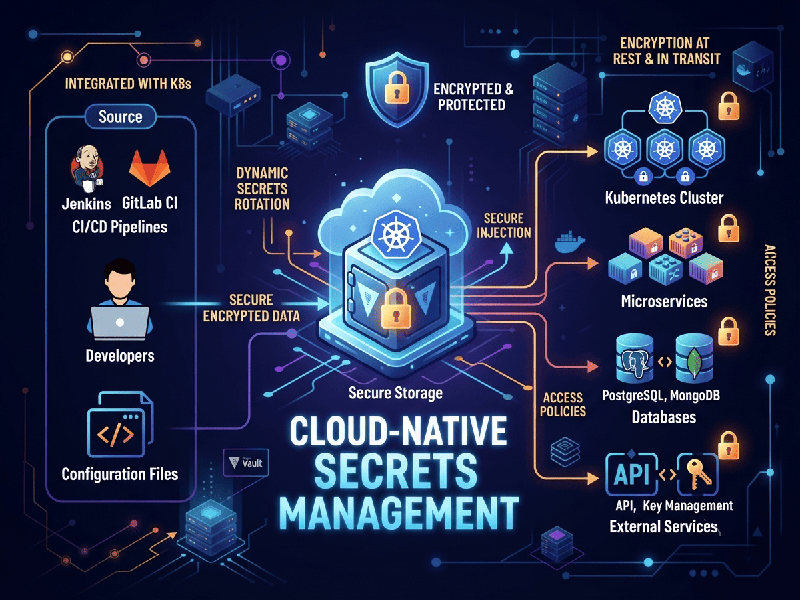
Cloud-Native Secrets Management
Cloud-native secrets management is the practice of
securely storing, accessing, rotating, and auditing sensitive credentials—such
as API keys, database passwords, OAuth tokens, cryptographic certificates, and
connection strings—across highly dynamic environments like microservices,
Kubernetes clusters, and serverless architectures.
Because cloud-native systems scale rapidly and rely
heavily on automation, traditional methods (like storing secrets in
configuration files or environment variables committed to version control)
introduce severe security vulnerabilities.
1. Core Pillars of Cloud-Native Secrets Management
A robust secrets management strategy relies on several
foundational architectural layers:
- Centralized Secure Vaults: Utilizing dedicated secrets
management platforms (such as HashiCorp Vault, AWS Secrets Manager, Azure
Key Vault, or Google Cloud Secret Manager) to establish a single,
encrypted source of truth.
- Dynamic and Ephemeral
Credentials:
Moving away from static, long-lived passwords. Instead, systems generate
temporary credentials on-demand that automatically expire (TTL) after a
short operational window.
- Workload Identity Federation: Eliminating static API keys for
applications and CI/CD pipelines by using token-exchange models (like
OpenID Connect / OIDC) to authenticate workloads dynamically through
trusted external identity providers.
- Zero Hardcoding & Pre-Commit
Scanning:
Enforcing strict policies via git hooks, CI pipeline scans (e.g.,
Trufflehog, Gitleaks, GitGuardian) to block hardcoded credentials before
they ever reach a code repository.
2. Implementation Framework in Kubernetes &
Cloud Environments
Deploying secrets effectively across modern
infrastructure requires integrating directly with orchestration and runtime
pipelines:
- External Secrets Integration: In containerized ecosystems
like Kubernetes, avoid using raw native Secret objects insecurely. Use
tools like the External Secrets Operator to safely sync secrets
from your centralized vault directly into ephemeral cluster pods at
runtime.
- Automated Secret Rotation: Configure event-driven or
scheduled rotation scripts (using serverless functions or native vault
automation) to regularly update database credentials and API tokens with
zero downtime.
- Granular Least-Privilege Access
(RBAC): Map
access policies strictly so that individual workloads, services, and
developers can only read the exact secret namespaces or keys required for
their specific function.
- Immutable Audit Logging: Capture every read, write,
rotation, and access failure attempt into a tamper-proof log stream,
routing data to a SIEM platform for anomaly detection.
3. Key Benefits & Operational Best Practices
Adopting a mature cloud-native approach fundamentally
changes your security posture:
- Eliminate Secret Sprawl: Centralizing visibility stops
developers from scattering copies of production keys across local
machines, team wikis, and unsecured configuration files.
- Drastically Reduce Blast Radius: If a short-lived, dynamically
generated database credential is compromised, its expiration window limits
potential damage to minutes rather than months.
- Streamline Compliance Audits: Automated logging and
centralized lifecycle management make meeting frameworks like SOC 2, ISO
27001, and PCI-DSS significantly smoother.
- Local & Regional Alignment: When handling cross-border
microservices or processing sensitive regional compliance data, ensure
your secret storage backends and encryption keys are governed by
appropriate geographic security policies (such as local data residency
requirements or regional currency/financial API compliance).