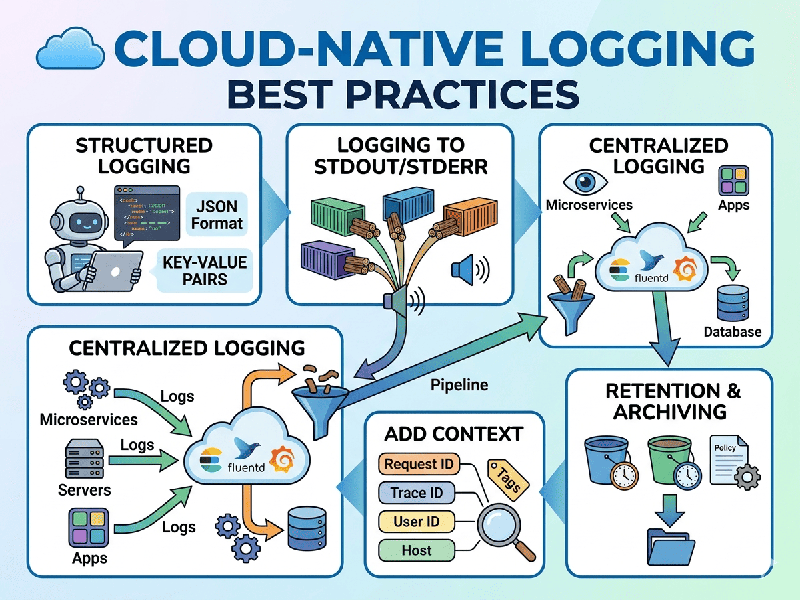
Cloud-Native Logging Best Practices
In a cloud-native environment—characterized by ephemeral
containers, microservices, and high-velocity deployments—traditional logging
(SSHing into a server to read a .log file) is no longer viable. Effective
logging in 2026 requires a shift toward Observability, where logs are
treated as structured event streams.
1. Implement Structured Logging (JSON)
The most critical practice is moving from raw text to Structured
Logging. Machines, not humans, are the primary consumers of logs in
cloud-native stacks.
- Format: Standardize on JSON. This
allows logging platforms (like ELK, Loki, or Datadog) to parse fields
automatically without complex RegEx.
- Standard Fields: Every log should include:
o trace_id: To correlate logs across
multiple microservices.
o service_name: The originating app or
component.
o severity: (INFO, WARN, ERROR) for
easy filtering.
o timestamp: In ISO 8601 format
($YYYY-MM-DDTHH:mm:ssZ$).
2. Centralized Logging Architecture
In Kubernetes and serverless environments, logs disappear
when a pod or function terminates. You must "ship" logs to a central
repository immediately.
- Log Shippers: Use lightweight agents like Fluent
Bit or Promtail as Sidecars or DaemonSets to collect and
forward logs.
- Decoupling: Use a buffer (like Kafka
or Redis) between your log shippers and your storage backend. This
prevents your logging system from crashing if there is a sudden spike in
log volume.
3. Adopt Open Telemetry (OTel)
By 2026, vendor-neutral standards are the norm. OpenTelemetry
allows you to instrument your code once and send telemetry to any backend
(e.g., from Grafana Loki to New Relic) without changing your application code.
- Correlation: OTel simplifies the
"Golden Triangle" of observability by linking Logs, Metrics,
and Traces together using a shared context.
4. Log Rotation and Tiered Retention
Cloud-native logging can become the most expensive part of
your infrastructure if not managed.
- Storage Tiering:
o Hot: Keep the last 7–14 days of logs in
high-performance storage (SSD) for immediate troubleshooting.
o Warm/Cold: Move older logs to object storage
(like AWS S3 or Google Cloud Storage) for compliance and long-term auditing.
- Sampling: For high-volume INFO logs,
consider sampling (e.g., logging only 10% of successful requests) to save
on ingestion costs while keeping 100% of ERROR logs.
5. Security and Compliance
Logs often accidentally capture sensitive data (PII).
- Dynamic Masking: Implement middleware that
automatically redacts credit card numbers, passwords, or emails before
they leave the application.
- Immutability: For audit logs (SOC2/HIPAA
compliance), ensure logs are stored in "Write Once, Read Many"
(WORM) storage to prevent tampering.
- RBAC: Use Role-Based Access Control
to ensure developers can see application logs but not sensitive security
or financial logs.