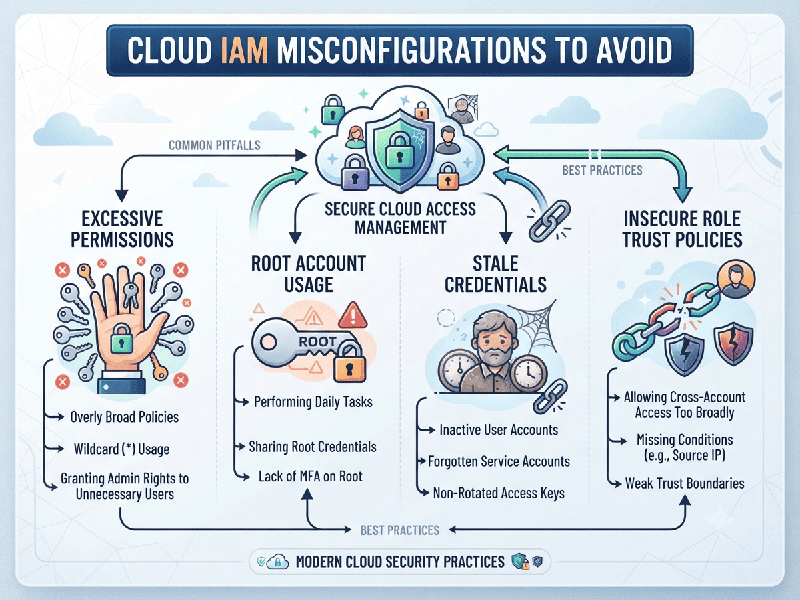
Cloud IAM Misconfigurations to Avoid
Identity and Access Management (IAM) misconfigurations
are a leading vector for cloud security breaches. Because cloud environments
scale rapidly, minor oversight in permission boundaries or credential
management can give attackers a clear path to lateral movement and data
exfiltration.
1. Over-Permissive Policies & Wildcard (*) Overuse
- The Risk: Granting broad permissions
(such as Action: "*" or Resource: "*") for
convenience. If a user account, API key, or compute workload is
compromised, attackers inherit total administrative control over the
environment.
- How to Avoid It: Enforce the Principle of
Least Privilege (PoLP). Use automated tools like cloud-native policy
generators or Cloud Infrastructure Entitlement Management (CIEM) solutions
to analyze actual user activity and trim unused permissions.
2. Unmanaged & Over-Privileged Non-Human
Identities (Service Accounts)
- The Risk: Focusing solely on human users
while ignoring machine identities (such as service accounts, API tokens,
lambdas, and CI/CD runners). Hard-coded or long-lived service account
tokens often carry excessive permissions and rarely undergo credential
rotation.
- How to Avoid It: Treat machine identities with
the same rigorous governance as human users. Use short-lived tokens,
workload identity federation where available, and automated credential
rotation.
3. Privilege Escalation Paths
- The Risk: Giving a user or role seemingly
limited permissions that inadvertently allow them to grant themselves
higher access (e.g., permissions like iam:CreatePolicyVersion,
iam:SetDefaultPolicyVersion, or sts:AssumeRole linked to overly broad
targets).
- How to Avoid It: Audit IAM policies specifically
for privilege escalation vectors. Restrict dangerous control-plane actions
so that standard users cannot alter policy documents, attach administrator
roles, or create new access keys.
4. Neglecting Multi-Factor Authentication (MFA)
- The Risk: Allowing console or
programmatic access using only a password or static access key, leaving
accounts vulnerable to credential stuffing, phishing, or brute-force
attacks.
- How to Avoid It: Enforce universal MFA
across all human accounts without exception. Implement Conditional Access
policies that mandate hardware tokens or phishing-resistant authentication
methods for high-privilege operations.
5. Overly Broad Cross-Account Trust Relationships
- The Risk: Misconfiguring trust policies
on IAM roles to allow external AWS accounts, third-party SaaS vendors, or
public entities to assume roles into your environment without strict
external IDs or condition constraints.
- How to Avoid It: Restrict trust policies using
explicit Condition blocks (e.g., aws:PrincipalTag or sts:ExternalId).
Regularly review resource-based policies and trust relationships using
automated cloud posture management tools to block unintended cross-account
exposure.