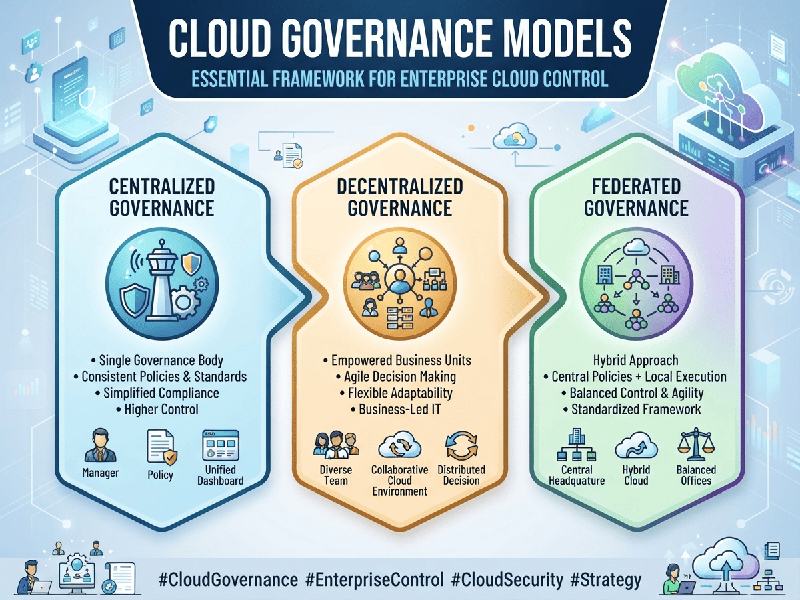
Cloud Governance Models
A cloud governance model is a framework of policies,
procedures, roles, and automated controls that an organization uses to manage
its cloud computing environment. It establishes guardrails to ensure security,
regulatory compliance, performance, and cost efficiency (such as monitoring
cloud spend in ₹ across enterprise budgets) without slowing down engineering
velocity or stifling innovation.
Core Pillars of Cloud Governance
A robust governance framework is typically built
across five key functional areas:
1.
Cost & Financial Management (FinOps):
o Tracks and allocates cloud
expenditure, sets budget alerts, eliminates idle resources, and optimizes
reserved instances or savings plans to prevent unexpected cloud bills.
2.
Security & Risk Management:
o Enforces data encryption (at rest and
in transit), manages identity and access management (IAM) permissions, and
continuously scans for infrastructure vulnerabilities.
3.
Identity & Access Management (IAM):
o Implements the principle of least
privilege, multi-factor authentication (MFA), role-based access control (RBAC),
and centralized single sign-on (SSO).
4.
Resource Consistency & Configuration:
o Standardizes naming conventions,
tagging policies, and architectural blueprints so resources across multi-cloud
environments remain organized and auditable.
5.
Compliance & Regulatory Alignment:
o Ensures infrastructure meets industry
standards and legal requirements (such as GDPR, HIPAA, or local data residency
mandates) through automated auditing tools.
Common Cloud Governance Framework Models
1.
Centralized Governance (Top-Down):
o How it works: A central cloud center of excellence
(CCoE) or IT team defines and manages all policies, security controls, and
resource provisioning.
o Best for: Highly regulated industries with
strict compliance requirements, or smaller organizations with centralized IT
teams.
o Trade-off: Can create bottlenecks for developer
speed and innovation.
2.
Decentralized Governance (Autonomous):
o How it works: Individual product or engineering
teams have full autonomy to manage their own cloud environments, budgets, and
security parameters.
o Best for: Fast-paced startups and agile tech
companies prioritizing speed.
o Trade-off: High risk of "shadow IT,"
security misconfigurations, and runaway cloud costs.
3.
Federated / Hub-and-Spoke Governance (Balanced - Recommended):
o How it works: A central IT/security team
establishes baseline enterprise guardrails, policies, and master landing zones
(the "Hub"), while individual business units or product squads have
the autonomy to build and operate within those guardrails (the "Spokes").
o Best for: Enterprise organizations seeking a
balance between strict security/cost control and engineering velocity.
Key Enablers for Effective Cloud Governance
- Policy as Code (PaC): Automating governance by
writing infrastructure policies in code (using tools like Terraform, Open
Policy Agent, or AWS CloudFormation Guard) so configurations are checked
automatically before deployment.
- Automated Guardrails &
Remediation:
Setting up automated scripts or native cloud policies (such as AWS
Organizations SCPs or Azure Policy) that block non-compliant deployments
or automatically remediate drift.
- Continuous Monitoring: Utilizing Cloud Security
Posture Management (CSPM) and FinOps dashboards to maintain real-time
visibility into security posture and spending metrics.