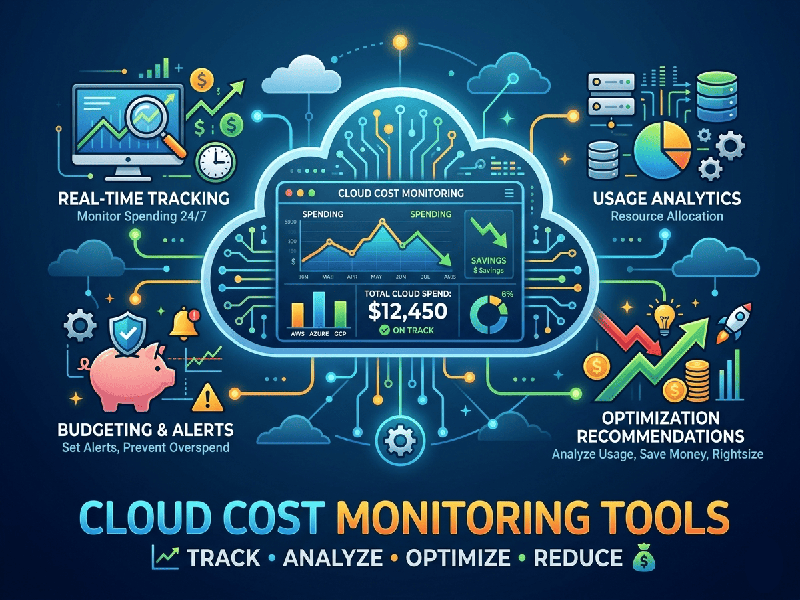
Cloud Cost Monitoring Tools
Managing cloud costs effectively is critical for scalability. In 2026, the best approach is to utilize tools that offer FinOps (Financial Operations) capabilities, allowing you to not just track costs, but forecast and optimize them in real-time.
5 Strategies for Effective Cloud Cost Monitoring
1. Tagging Hygiene
You cannot manage what you cannot identify. Enforce a strict Resource
Tagging Policy. Every virtual machine, database, and storage bucket should
be tagged by:
- Environment (e.g., Development, Production)
- Department (e.g., Engineering, Marketing,
Operations)
- Project/Owner (e.g.,
Agrived-Food-Export-Initiative)
2. Implement Automated Forecasting
Move away from spreadsheet-based budgeting. Use your tool’s Forecasting
features to simulate future spend based on current growth trends. This prevents
"bill shock" by alerting you before you cross your budget
threshold.
3. Adopt Rightsizing and Cleanup
Cloud providers often charge for idle resources.
- Idle Detection: Automatically flag databases or
instances that have had zero activity for more than 48 hours.
- Rightsizing: Regularly analyze CPU/Memory
utilization to downgrade instances that are over-provisioned (e.g., an
8-core instance running at 5% utilization).
4. Leverage Reserved Instances (RIs) and Savings Plans
For predictable workloads, shift from "On-Demand"
pricing to Savings Plans or Reserved Instances. This can often
yield a 30% to 60% reduction in compute costs.
5. Utilize "FinOps" Culture
Cloud cost is not just an IT responsibility; it is a
financial one. Create monthly "Showback" reports that allow team
leads to see the direct correlation between their project's activity and the
resulting cloud spend.