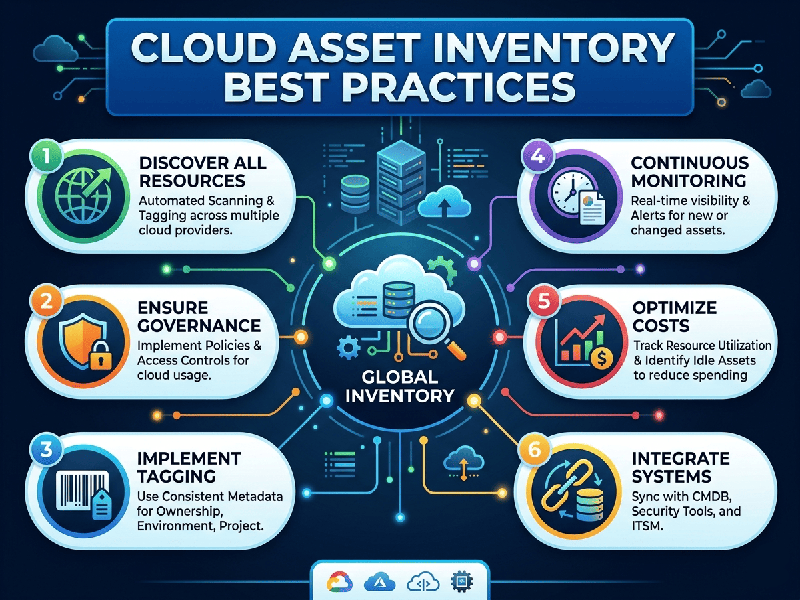
Cloud Asset Inventory Best Practices
Cloud asset inventory has evolved from a passive, manual
tracking exercise into a continuous, automated, and policy-driven discipline.
Effective inventory management is now the foundation for FinOps, security
posture management, and compliance.
1. The Strategy: "Policy-as-Code" First
Modern inventory management moves away from reactive
spreadsheets toward proactive, automated enforcement.
- Define Before You Discover: Before deploying assets,
establish tagging and naming conventions as code (e.g., via Terraform or
CloudFormation). If an asset is deployed without the required metadata, it
should be automatically flagged, quarantined, or terminated.
- Mandatory Metadata: Enforce a minimum set of tags
for every asset: Environment (prod/dev), Owner, CostCenter,
ApplicationName, and CreatedDate. This is your "universal
language" for cross-cloud analysis.
- Codify Governance: Use tools like AWS Config,
Azure Policy, or Terraform Sentinel to define "what good looks
like." This ensures your inventory is not just a list of assets, but
a list of compliant assets.
2. The Mechanics: Continuous, Automated Discovery
Static, periodic scans are insufficient for dynamic cloud
environments.
- Event-Driven Discovery: Move to real-time discovery
mechanisms (e.g., CloudTrail/EventBridge integration) that trigger an
inventory update the moment an API call occurs to create, modify, or
delete a resource.
- Unified Multi-Cloud View: Avoid logging into multiple
consoles. Implement a centralized Asset Inventory dashboard (either native
tools like GCP Asset Inventory, or third-party platforms) that normalizes
data from all providers into a single, searchable schema.
- Deep Contextualization: Raw lists are useless. Your
inventory must map dependencies. Knowing you have an EC2 instance
is less important than knowing which application it supports, who owns it,
and how much it costs per hour.
3. Security & Compliance Integration
An unmanaged asset is an unmanaged risk.
- Shadow IT Identification: Use Identity Providers (IdP)
and Cloud Access Security Brokers (CASB) to discover unauthorized SaaS
subscriptions and rogue cloud accounts.
- Integrated Remediation: The most mature organizations
integrate their inventory tool with automated response systems (e.g.,
serverless functions like Lambda). If an asset is detected with public
exposure or missing encryption, the system can automatically remediate the
configuration without human intervention.
- Audit Readiness: Treat your inventory as an
"audit-ready" record. By mapping assets to security frameworks
(like CIS benchmarks) in real-time, you can generate compliance evidence
in minutes rather than weeks.
4. Key Metrics for Success
If you aren't measuring these, you aren't managing the
inventory effectively:
- Mean Time to Inventory (MTTI): The time between an asset being
provisioned and appearing in your management system.
- Tag Coverage Percentage: The percentage of assets
meeting your mandatory tagging policy (aim for >95%).
- Drift Detection Rate: The frequency with which assets
deviate from their "as-deployed" configuration.
- Orphaned Asset Identification: Proactively identifying
resources (like unattached disks or idle load balancers) that are
incurring costs without providing business value.