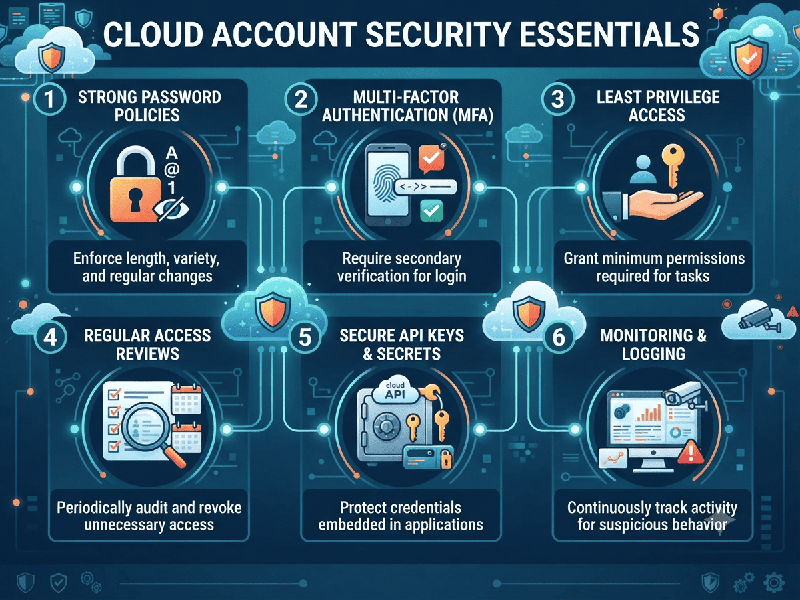
Cloud Account Security Essentials
Securing cloud accounts requires shifting away from
traditional network perimeters and focusing heavily on identity, least
privilege, continuous posture management, and data protection.
1. Identity and Access Management (IAM) Essentials
With cloud architecture, identity is the new
security perimeter. Most cloud breaches stem from compromised credentials
or overly permissive account settings rather than software hacks.
- Enforce Multi-Factor
Authentication (MFA): Mandatory MFA on all human accounts—especially privileged and
administrative accounts—is a non-negotiable baseline to block automated
credential stuffing and phishing.
- Apply the Principle of Least
Privilege:
Grant users, applications, and service accounts only the precise
permissions required to perform their tasks—nothing more.
- Eliminate Standing Admin Access: Move away from permanent
"god-mode" administrative roles. Implement Just-In-Time (JIT)
elevation so high-level privileges are granted only temporarily when
needed.
- Kill Long-Lived Secrets: Avoid hardcoded API keys or
long-lasting access tokens. Use short-lived credentials, secure vaults,
and automated key rotation.
2. Cloud
Security Posture Management (CSPM)
Human error and configuration drift are leading causes
of cloud data exposure. CSPM tooling provides continuous visibility and
automated oversight.
- Maintain Real-Time Asset
Inventories:
Track multi-cloud environments (AWS, Azure, GCP) to eliminate hidden or
forgotten "shadow IT" resources, test accounts, and unmonitored
development nodes.
- Scan for Misconfigurations: Continuously monitor storage
buckets (e.g., public AWS S3 buckets), database exposure, and open
security groups that can leak data instantly.
- Automate Remediation: Use policy-as-code and
auto-remediation frameworks to automatically close security gaps the
moment configuration drift is detected.
3. Data Protection and Encryption
Assume that a perimeter can eventually be breached,
and ensure that data remains unreadable and secure at all levels.
- Encrypt Everywhere: Encrypt data at rest
(databases, disks, storage volumes, backups) and in transit (using
secure TLS protocols for all internal and external communication).
- Own Your Key Management: Utilize native Key Management
Services (KMS), restrict who can access cryptographic keys, and ensure
scheduled key rotations.
4. Visibility, Logging, and Threat Detection
A log that is collected but never reviewed offers zero
protection during an active incident.
- Enable Native Audit Trails: Turn on comprehensive logging
services (such as AWS CloudTrail, Azure Monitor, or Google Cloud Audit
Logs) across all accounts, not just production environments.
- Behavioral Anomaly Detection: Implement monitoring tools that
flag suspicious patterns, such as unusual API call volumes, logins from
unexpected geographic locations, or unexpected privilege escalations.